Tending the garden: San Juan Islanders choose community over chaos
Published 1:30 am Thursday, March 19, 2026
By Darrell Kirk
Staff reporter
The news arrives in waves: a war in the Middle East, soldiers deployed without congressional debate, a federal government shifting the ground beneath people’s feet each week. For residents of the San Juan Islands, the distance from Washington, D.C., can feel both like a blessing and a torment. One can see the stars here, hear the tide. And yet the world flickers on every phone and in the worried eyes of neighbors.
How does an islander respond? Conversations across the archipelago reveal a community arriving, from very different directions, at the same answer: start where you are.
Tend your own garden first
Robin Riegsecker, an Orcas Island resident who worships with a Mennonite home congregation, is candid about the weight she carries. The attack on Iran, the erosion of institutional checks, the relentless media cycle — it has been overwhelming.
“It seems like the goal of the media blitz is to have us feel helpless and to just shut us down. You gotta take care of yourself … make sure you’re getting help with your feelings. Constructive help, so that you have something to give.”
From there, she says, look outward — but close first. “Pay attention to your neighbors and your family. Two people [are] twice as [many] as one person. Just try to keep the fabric of this community as tight and healthy as possible.”
Christine Jennifer, an Orcas Island resident, frames it in the language of land. “To me, it’s kind of like gardening. You can’t ignore your garden for a week in spring and summer. You have to tend to it, water it, and interact with it.”
She calls it stewardship. “I try to live as a good steward of what I’ve been given: my family, my home, the island, the community. If I’m too extended, too drained, I’m kind of spinning out. And I don’t think that’s how I’m supposed to live.”
Across generations
Jean Henningson, a retired dance teacher on Orcas Island, does not counsel passivity in these times. “This kind of thing happens again and again. You can’t stand back and do nothing.”
She worries younger people don’t understand how much can be lost — then catches herself. “Maybe the younger generation is a lot more upset and knows a lot more than I do. I don’t know.”
Her advice: “To take whatever action we can. And to balance it — to cherish those around you and to make the most of the joy that you experience in your life.”
The canoe and the council circle
Matt Wickey, an outdoor educator and conservation biologist via Hawaii on San Juan Island, keeps noticing a gap: the women are organizing, connecting, building. The men are not.
“The men are struggling. There’s a lot of alcoholism, a lot of stuff going on in the islands. You hear all about the women’s groups, all the awesome stuff the women are doing. But the men aren’t really showing up.”
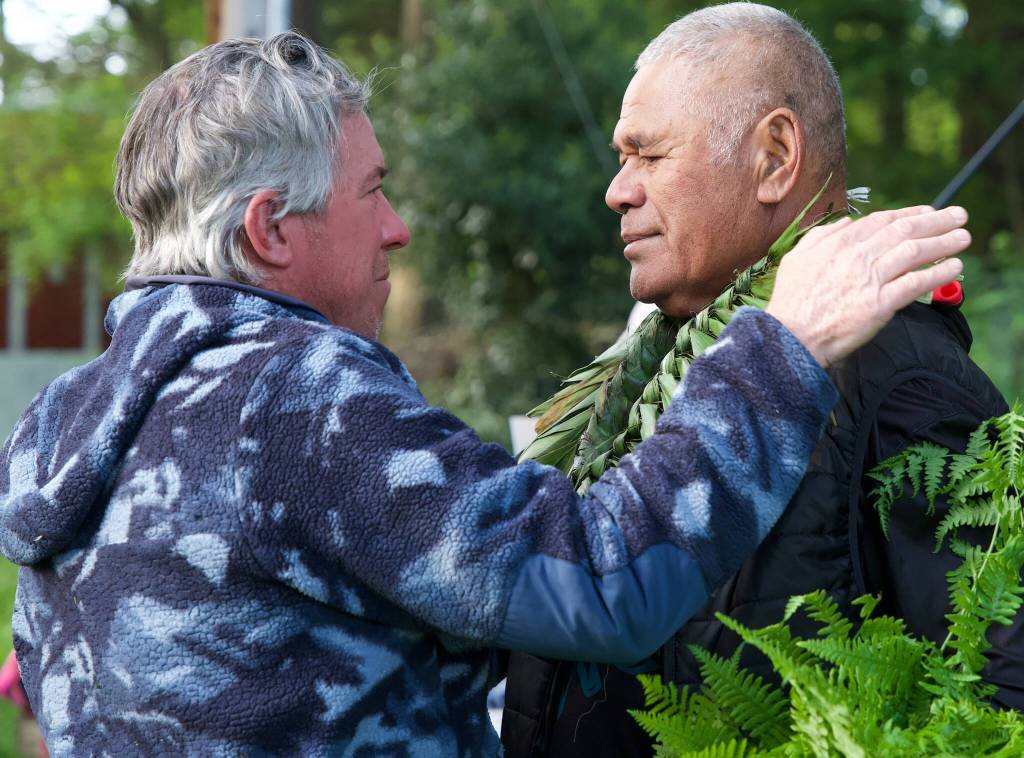
His response is the Illuman group — men’s council circles rooted in depth psychology and indigenous tradition — which he is bringing to the islands. He also runs a voyaging canoe program. “The symbol of the canoe — being across the ocean, vast distances together, working together, dealing with all the stuff that arises — just brings people together.”
“A lot of families are broken. The tribal sense is just kind of broken a little bit. I’m trying to bring that back.”
Be prepared
Eric Stone — Eagle Scout, former aerial-navigator, aerial-photographer in Saudi Arabia, scoutmaster on San Juan Island — has a pragmatic answer in these times: teach people to do things. His troop meets year-round at Camp Bogardus on San Juan, where young people learn first aid, fire building, water purification, blacksmithing and emergency communication.
“So many of them feel lost or hopeless because they see the news. But they grab on to doing something as opposed to just being observers. They feel empowered when they learn how to do first aid, when they learn how to shoot a rifle accurately.”
Politics stay out of it — that, he tells the scouts, is between you and your parents. “By setting an example, maybe I’ll make them a little better person.”
Boots on the ground
Rebecca Hope, a Lopez Island resident and executive director of Lopez Children’s Center, is clear-eyed about the reach of her work. Early learning, she says, doesn’t cast a wide net — and that’s exactly the point. “A lot of our work is meant to be close to home here. Our job in early learning is to just kind of be boots on the ground, providing the consistency that children deserve.”
In turbulent times, that consistency is its own form of resistance. Families need to work. Children need to be held. “Our job is to provide well-being for parents and for kiddos.”
But Hope’s most pressing mission goes beyond daily care. She sees her deepest advocacy work as inclusion — ensuring that every child, regardless of need or income, has a seat at the table. Children with special needs, challenging behaviors, trauma in the home and families receiving public subsidies are too often denied equitable access to early learning spaces.
Her answer is to accept them all. “When I think about my work in terms of advocacy, it’s about supporting families, but also about creating educational environments for early learners that are inclusive and that allow all children to attend.”
Social media: Connection and wedge
Riegsecker sees social media as a lifeline — a way to reach someone you’d otherwise lose touch with, rally support around a family in crisis, keep scattered loved ones close. Sharon Abreu, a peace activist and professional singer and musician on Orcas, uses it to share photos of the weekly Sunday vigil in Eastsound — images that reach her college roommate in Athens, Greece. “The world has gotten smaller. We need to know each other. We need to build trust.”
But Jennifer warns the same platforms accelerate division and unreality. “Although it connects us more, it also isolates us more in insular thinking. I don’t think we’re practicing critical thinking when we’re just getting snippets and memes. All the fakery is really concerning. We’re missing what’s right in front of our face. We’re chasing the rabbit.”
Something real to stand on
Abreu last weekend stood at the gates of the Bangor nuclear submarine base near Port Orchard, Washington, providing music for an anti-nuclear protest. She has done work like this for decades and is not interested in anyone opting out.
“Just showing up when there’s an event, to show the numbers — every community is out there. We have to take responsibility for each other, and for what is being done to people around the world in our names.”
But she lands, like everyone else, on balance. “You’ve got to decide how much you can do with all your other responsibilities. You don’t want to make yourself sick. You want to say, hey, I did something today.”
Riegsecker finds her balance each week in the Orcas Island Choral Society. “To be in a group — it’s sort of like being on a basketball team, but not as much sweat. You’re working on something that can only be done as a group. There’s just something good for my soul in that.”