Budget cut discussions include the Environmental Stewardship Department
Published 1:30 am Sunday, June 28, 2026
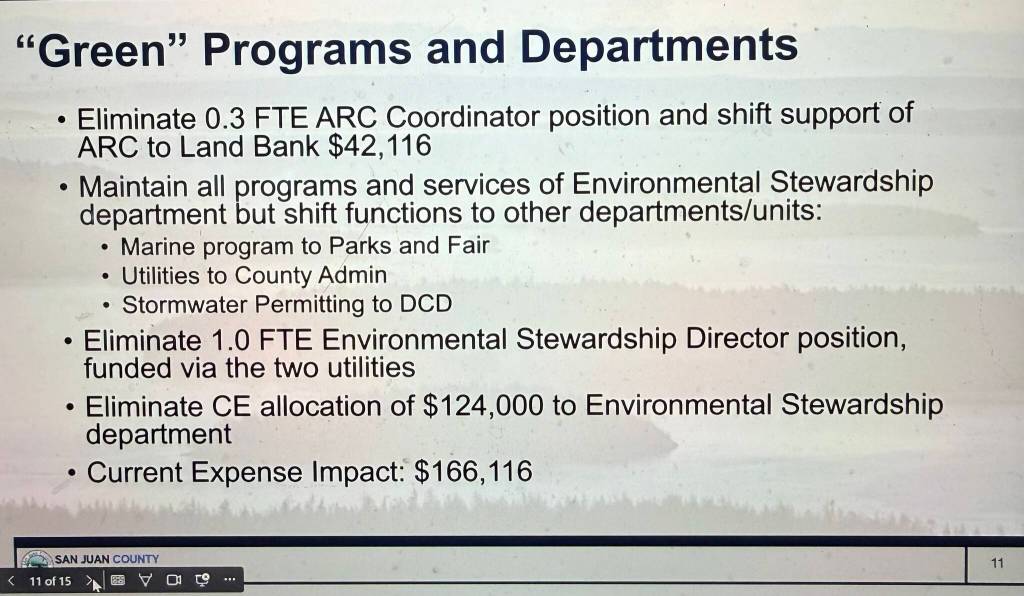
During budget discussions on June 24, San Juan County Manager Jessica Hudson proposed a reorganization of the County’s green programs, including eliminating the Environmental Stewardship Department director position, moving the marine program to Parks and Fair, and shifting utilities (like solid waste and clean water) to County Administration, where 50% of the deputy manager’s salary would be designated to those programs.
“None of my recommendations devalue the work that has been done by these roles,” Hudson told the Council. “We simply don’t have the money.”
The cost savings of cutting the position was estimated to be $124,000.
Budget discussions continued on June 29 and 30, during which approximately 19 islanders addressed the Council during Citizens Access time, advocating to retain the director, who has been away on personal leave, to allow her to present her own budget, to keep the department under one umbrella and for transparency while making these and other budget decisions.
Kimbal Sundberg stated on June 29, at Citizens Access time, that he has concerns that the director had not been able to participate in budget discussions and present cuts she would make to address financial deficits. “Utilities were arguably bankrupt,” prior to the Environmental Stewardship Department, said Sunburg. Director Kendra Smith “has assembled an ace team and brought in tens of millions into the county in addition to the multitude of volunteers and local contractors supported by this program.”
He was followed by the youth representative of the Climate and Sustainability Committee, August d’Ambruoso. “By scattering and significantly reducing funding for these programs, you are fracturing the very things that need to be unified,” he told Council. “Instead of a cohesive, efficient environmental strategy, we will end up with administrative bottlenecks and communication gaps across the county’s departments.”
He also cited statistics from the Federal Emergency Management Agency showing that every dollar invested in proactive central mitigation saves communities $6 in repair costs.
June 30, still more islanders spoke.
“I have the privilege of working with hundreds of students every year. We teach that they have a role in protecting this place they call home, that stewardship matters, that their voices make a difference,” Jess Newley, community science and education director, told the Council. “But they are learning just as much from you. They are watching how leaders make difficult decisions, they are watching whether promises are honored, and if Environmental Stewardship is a priority, and if you have the courage to protect what matters, even when budgets are tight. This is one of those teachable moments; if stewardship is one of our core values, our actions must reflect that. Dismantling the Environmental Stewardship Department sends a very different message.”
Recent Friday Harbor High School graduate Flora Vaught, who had spoken to the Council mere months ago regarding Jackson Beach and the Eco-Club, expressed how proud she was to be from a community that invested so much in the environment, adding that fragmenting the Environmental Stewardship Department breaks that promise and forgets everything it has given to the community.
“This community lives and dies by the health of the land and water. The environment is core to our identity. It is our heart and our soul, and it is the ESD that keeps that heart beating.”
Upcoming FHHS senior Eleanora Cohen noted that students had asked the Council two weeks prior to keep the environment in mind when making decisions, and asked that they honor that agreement.
“The quality of science is dependent on the local ecosystems, and tourism is dependent on the environment. To support the environment is to support the economy,” Cohan said.
Former director of the University of Washington Marine Laboratories, Billie Swalla, backed up Cowan’s comments about scientists, saying, “The labs were put here because of biodiversity. There isn’t higher biodiversity anywhere else in the state of Washington. I worry that if the Environmental Stewardship Department is gone, the environment will degrade even more than it already has.”
She told the Council that when she moved to San Juan in 1999, one could go out to the Westside and reliably see Southern Resident killer whales; however, “we all know that is no longer a possibility. They are here one or two times, and that has been because of the degradation of the marine habitat.”
Chair of the Climate and Sustainability Committee, Chris Greacen, reminded Council of the environmental catastrophes barreling down on San Juan County, including sea level rise and hot, dry summers that threaten to bring a major wildfire incident.
“I know you have a tough budget decision to make, but the government can’t address what it is not paying attention to,” he said.
OPALCO board member Wendy Hiester spoke of how uniquely vulnerable the county is to climate change, including rising sea levels, changing marine ecosystems, wildfire and increasingly severe storms. The Environmental Stewardship Department, Hiester explained, has been working on state-mandated policies to produce locally sustainable energy and leading OPALCO and local environmental groups in creating a plan for a resilient future.
Council member Kari McVeigh, June 30, told her fellow Council members and attendees, “I want to assure the committees that any changes we are making in Stewardship administration don’t change our commitment. Our commitments would change if we eliminated the functions or if we eliminated some of the functions.”
She continued, saying that who will be supervising will change, which isn’t nothing; however, the nature of teams is that they change all the time.
“What I would propose, if this goes through, is for the departments to take on these tasks, add within the forefront or within the title, like ‘Environmental Marine Stewardship.’ … words do matter to show what we are trying to do. It would also be a great idea for staff to take on quarterly or however often a group meets, from the different environmental things we are working on to talk about where they intersect.”
“We heard from 16 people today during public access. The discussion needs to happen. … This is a proposal; we have had feedback. For me, this is not a foregone conclusion,” Council member Jane Fuller responded.
The Auditor’s Office will begin moving forward on the first draft budget, with the draft to be presented to Council Aug. 25. Between now and then, all Council members agreed, many more deliberations will occur, and will continue to occur through November.
The current exercise, Paulsen explained, was to ensure there was enough time for everyone to look at all the available information and be thoughtful about the proposals. The goal, McVeigh said, was to attempt to find the $4 million level of cuts in this first round of discussions. By the end of the exercise, that goal still fell short by approximately $300,000.
As this was only one of two departments not to have a budget presentation done by their department head (Facilities is the other), and that several public commenters urged the Council to allow for that, Fuller asked her seatmates for that to occur, and to have a budget spreadsheet Environmental staff prepared and sent to Hudson, Paulsen, Fuller and McVeigh incorporated into the presentation.
Fuller asked if the staff numbers were included, and why they were not forwarded to Council. Paulsen said he had received the spreadsheet from staff, but had not delved into it. McVeigh noted that she would be disappointed if Hudson had forwarded them to Council, as there had not been time to verify, compare and contrast with other numbers.
“I’ve seen it three years in a row, and none of it is a surprise,” Fuller said of the numbers on the spreadsheet.
When asked if Smith would be able to present a budget, Paulsen responded that, as per the County Charter, that decision is up to County Manager Hudson. McVeigh noted that while Smith was on leave, her duties were assumed by both our deputy County manager and our County manager. They were responsible for the Environmental Stewardship budget and met with staff for their budgetary recommendations.
During the June 30 meeting, Paulsen drew attention to what was referred to as “column F,” designated for one-time cuts. The director position falls into that category. Paulsen explained to the Journal later that when the Environmental Stewardship Department was formed five years ago, it was created quickly, with no dedicated funding, and primarily run on grants. His hope, Paulsen said, once solving for the budget crisis, is for the County to take time to decide what they want the department to look like, and to create a dedicated funding source.
“[If/when] we put it back together, we will have time to think about the best way to get this work done,” Paulsen told the Journal. “If we focus on that, we could have a positive outcome on this.”
When asked if he had anything to say to those who spoke before Council, particularly the youth, Paulsen responded, “I always love having people attending the meetings. Everyone has very passionate points. But I don’t think we can make decisions on sheer numbers.” He referred to cuts to health programs that would have significantly affected mothers, for example, and no mothers spoke against them, and that for every cut, there is a group passionate about it and affected by it.
McVeigh told the Journal she would tell the citizens who spoke that economic challenges of the County are dire, the failure of the levy lid lift and the shrinking federal and state budgets, coupled with overwhelming unfunded state mandates, make building a legally mandated balanced budget difficult.
“It will be impossible to create a balanced budget without a loss to programs that we want, need, and require. There will be no way for us to also build a balanced budget without a loss to service levels for our constituents. The pain will be real,” McVeigh said, encouraging citizens to continue communicating with Council.
“We are striving to create the least possible amount of harm as we balance the budget. Despite these tremendous challenges,” McVeigh continued, “ I have been heartened by the real engagement of the young people in our community. This may sound trite, but you truly are our future leaders. It is my sincere hope that the County will be able to secure increased funding so we can undo most if not all of these programmatic reductions.”
Fuller told the Journal she has a lot to say to the citizens who spoke, and that as an elected official, it is her duty to meet with them where they are.
“I was struck by the rapid response, and the articulate manner in which they spoke, the points they raised,” Fuller said. “Please continue to ask questions, continue to be curious in seeking answers as to how this is unfolding. Please don’t make uninformed assumptions at this difficult time. I believe we can and will work through this while maintaining our county’s ecosystem upon which we all rely.”
The video recording of the June 24 meeting can be viewed at https://sanjuancowa.portal.civicclerk.com/event/4313/files.
Videos of the June 29 and 30 meetings can be viewed at https://sanjuancowa.portal.civicclerk.com.