

Editor’s note: This story will be updated after the Dec. 9 Council meeting.
By Darrell Kirk
Journal contributor
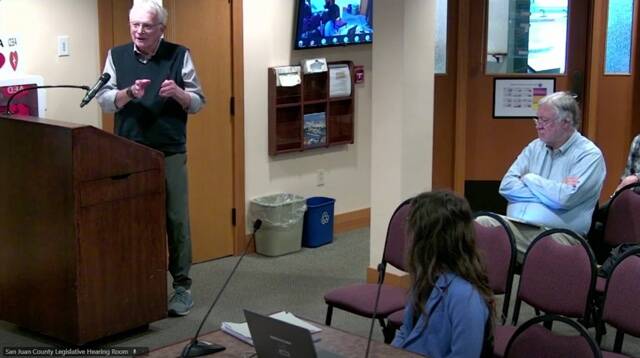
San Juan County Council heard impassioned testimony at a County Council meeting held on Nov. 25 from residents opposing a proposed rezoning that would expand Roche Harbor Resort’s master plan area by 119 acres, moving development capacity from wetlands to five parcels along Roche Harbor Road.
The proposal would not increase the total number of allowable dwelling units — which remains capped at 180 — but would relocate where those units could be built. County officials explained that the existing 180-unit allocation has been approved for years but sits on wetland areas that make development impractical. The rezoning would also require properties to maintain a 150-foot buffer from Roche Harbor Road and preserve 40% open space.
“The original resort recreational area that is currently still in place has a listed capacity in the plan for 180 dwelling units,” explained Sophia Cassam, county planner III. The rezoning would expand the designated area from 180 acres to 277 acres by incorporating five parcels currently zoned for rural residential use at one unit per five acres.
Local residents expressed alarm about the proposal’s impact on their community’s character. Tom Tucci, who has owned property at Bellevue Farms since 1997, voiced strong opposition.
“I think it changes the rural character. I think there’s a ton of issues with the wetlands and the way the water flows there,” Tucci said. He requested a substantial buffer area along Roche Harbor Road if development proceeds.
Glen Corson questioned why Roche Harbor should be allowed to remove acreage from rural residential status, saying, “I do not see a good reason to allow Roche Harbor to increase the size of their resort by 119 acres.” Noting the loss of trees the development would cause, he invoked the memory of community member Casey Baisch, asking council members, “What would Casey do?”
Kim Corson, who lives directly across from the proposed development at 105 Webster, raised concerns about environmental impacts. “Anybody that walks through those trails from fall, winter, spring knows there’s standing water everywhere there,” she said, questioning how the project would avoid disrupting local ecology.
Warren Appleton, MD, San Juan District 3 fire commissioner, speaking as a private citizen, challenged the characterization of the development. He noted that he lives within 900 feet of Roche Harbor and observed that existing houses sit mostly empty. “I walked Roche Harbor yesterday. Those houses have nobody in them, maybe five in all of them,” he said, noting they function essentially as Airbnb properties where owners buy the home, and then you can sublet it.
“Let’s not use the word homes. Let’s use the word part-time rentals that the owner of the home can live in during those beautiful three months in the summer,” Appleton said. He questioned what would happen in the rural area across the street, noting that golf courses are permitted on rural property. “Golf courses aren’t the way they used to be. The different insecticides, herbicides, et cetera, could poison our land.”
Speaking about his experience as a fire commissioner, though again clarifying he was representing only himself, Appleton added, “We’re pretty used to poisoned wells. We’ve been watching it now for a couple of years.”
He calculated water needs at “180 times 400 gallons per day. That’s what the usual home uses. So you have about 7,200 extra gallons.” He questioned where the water and waste would go, along with concerns about oil from golf carts. Appleton also raised fire safety concerns: “Roche Harbor right now, you can’t get a fire engine up those roads. Roads are too narrow; they have parking on them. So you basically have a Pacific Palisades opportunity there as far as fire goes.” He concluded by suggesting the Council “get a firm commitment out of Roche that there’s no golf course going in at any time ever.”
Resort general manager Matthew Allen attempted to address some concerns, stating that Roche Harbor is committed to developing year-round rental housing for employees and community members, with at least half priced approximately 20% below market rates. However, Allen acknowledged that “the feasibility of any specific development is still being determined.”
The three Council members showed varying perspectives on the proposal. Council Chair Kari McVeigh focused on getting affordable housing commitments in writing, referencing previous conversations with Allen about plans for approximately 48 manufactured homes for year-round management-level employees. Council member Jane Fuller expressed concerns about the lack of written documentation and late-stage nature of the discussion, noting she had received no prior public comment on the issue and had never spoken with the resort’s general manager. Council member Justin Paulsen asked technical questions about buffers, unit allocation and the Planned Unit Development process, seeking clarification on how the rezoning would function.
Council members expressed interest in codifying Allen’s commitments regarding affordable housing and rental restrictions, but noted that nothing has been submitted in writing. The hearing was continued to Dec. 9 to allow time for additional information and deliberation.