By Darrell Kirk
Journal contributor
When San Juan County residents purchase property on the islands, they become both private landowners and members of Orcas Power & Light Cooperative/Rock Island, a member-owned nonprofit utility serving the county since 1937. This dual role creates a unique tension between individual property rights and collective cooperative responsibilities, particularly when utility infrastructure crosses private land. Such is the case with property owners Elizabeth Covert and her husband, Denis Goudie, who have taken legal action against OPALCO/Rock Island Communications. Their neighbors, Norma and George Andreadis, are taking action in a similar lawsuit against the utility.
The dispute
The facilities in question include what the County code designates as Category B Joint-Use Wireless Facilities. According to documents filed in San Juan County Superior Court, these structures house equipment for T-Mobile and Rock Island Communications. The lawsuit, filed by property owners Covert and Goudie, alleges that wireless facilities and associated equipment were installed on their property without proper permits or easements.
The plaintiffs purchased their residential parcel on San Juan Island in September 2017. According to the lawsuit, their title report showed a 10-foot-wide easement for landscaping granted to a neighbor. The easement described its only intended purpose as landscaping and explicitly allowed the plaintiffs’ property to continue all surface activities in the area of the easement, including landscaping. The lawsuit notes that the easement contains no accommodation for utilities to be placed above ground and was granted only to the adjacent property, not directly to OPALCO/Rock Island, with no assignment recorded.
According to Covert and Goudie, when they purchased their land, they inquired about a wooden tower structure. They were told by Rock Island’s then-CEO that it was for emergency services, sheriff communications and smart grid purposes, which they supported as beneficial to the community. However, in late August 2023, the plaintiffs were made aware of extensive activity on their property due to excessive noise. They discovered a new 120-foot steel tower and associated equipment, including transformer enclosures, a generator and fuel supply.
Covert described the lack of communication, wondering “Why [did] they never talked to us about it, because it was on our property? They went through the whole planning and process to install the installation. They had never reached out to us as the property owners to let us know they were doing this work on our property.” She explained how they learned about the installation: “It was one of our neighbors that said, ‘Hey, what’s going on up there?’ That’s what alerted us because we can’t see it from where we are now. We live on the adjoining property, and it’s uphill and out of sight from us.”
The cooperative model and member obligations
According to OPALCO/Rock Island’s documentation on member privileges and obligations, cooperative members receive electricity at cost-of-service rates rather than market-driven prices and have democratic participation rights through board elections. In exchange for these benefits, members are expected to provide necessary easements for infrastructure development, access and maintenance. The cooperative’s fact sheet states that providing easements ensures reliable service and allows for system upgrades without unnecessary delays and expenses. Member-shared easements are described as standard practice in electric cooperatives and are essential for keeping rates low for the entire membership.
OPALCO/Rock Island’s policies indicate that the cooperative does not support monetary compensation for easements. According to communications from Krista Bouchey, OPALCO/Rock Island’s manager of communications, the cooperative and Rock Island provide services on a cost-of-service level and are not looking to make profits but to give members the best value for their money. Members must comply with cooperative policies, including safety regulations, meter access requirements and load management programs, with the documentation emphasizing that compliance helps maintain service reliability and operational efficiency.
The evolution of infrastructure
Covert and Goudie report that what began as a relatively unobtrusive installation evolved significantly. The original wooden tower was replaced with a steel structure 20 feet taller. The accompanying equipment expanded considerably, with a new cabinet installed on the plaintiffs’ side of the property line. The generator was increased in size due to the demand on electricity for the new installation, adding noise during startup cycles. According to the lawsuit, the defendant’s equipment produces sound from cooling fans cycling on and off, with additional noise coming from a box high on the tower.
The lawsuit also alleges that the facilities were placed at the highest elevation on the plaintiffs’ property, near the location with the best potential for a view. It states that the installation of the wireless facility without permission, permits or an easement, along with the above-ground related equipment, directly interferes with the use and enjoyment of the entirety of the plaintiffs’ property.
Access to the facilities presents another issue. According to the Andreadises, who own the neighboring property, access requires crossing approximately 300 feet beyond the end of the official road and their utility boxes. They describe this route as a dirt path created by driving over grass, not a documented right-of-way. The couple also reports discovering that underground utility lines were installed in the early 2000s running 20 feet inside their property line, with no documentation, permits, easements or markings.
County permitting process
San Juan County Director of Community Development Sev Jones confirmed in correspondence to the Journal that the county received one permit application in 2019 from Rock Island Communications for the placement of a propane tank and generator for utility backup power. Jones stated that the permit application was not approved because the County needed additional information from the applicant regarding easements on the property, and such clarifying information was not submitted. Jones noted that “this is a cursory review, and a formal Public Records Request could provide additional information on this property.” The Andreadises described their search efforts:
“We had a couple of people look for us, and we also looked ourselves at the San Juan County Permit Office. We also had our attorney request any non-recorded permits, which I understand is a legal possibility, but no permits showed up. He also looked, and we looked for any easements across our property—you know, like you would normally grant for utilities or for a cell tower. There are no easements on our property. The only easement belongs to the five parcel owners to bring power up the road, and that has nothing to do with the cell tower.”
Covert and Goudie subsequently filed a code violation case with San Juan County. They noted that having an unpermitted structure on their property could prevent them from selling or building on the land until the violation is satisfied. According to interview transcripts, San Juan County did not have a code enforcement officer at the time property owners initially sought information, but one was hired several months later.
In an email regarding the case in a reply to the Journal, Bouchey stated, “OPALCO/Rock Island follows all permitting requirements when installing infrastructure, and no violations have been identified.”
Community benefits of T-Mobile/Rock Island partnership
The partnership between OPALCO/Rock Island Communications and T-Mobile was announced in early February 2016. According to OPALCO/Rock Island’s agreement with T-Mobile, the partnership brings together respective assets to provide LTE wireless internet connections and public safety communications. The arrangement involves T-Mobile providing fixed LTE equipment configured for OPALCO/Rock Island’s licensed 700 MHz frequency, while Rock Island installs it. By the year’s end of the initial rollout, T-Mobile equipment on approximately 40 utility pole sites countywide was intended to provide services to the majority of OPALCO/Rock Island members through either fiber-based or LTE-based internet service options.
The agreement states that no money was to be exchanged between OPALCO/Rock Island and T-Mobile, with each entity retaining ownership and control of its own equipment and spectrum. OPALCO/Rock Island meters and bills Rock Island for the power used to run T-Mobile equipment.
By working together, the parties avoided costs and accelerated construction of the fixed LTE network, reducing the planned 120 poles to approximately 40 poles. OPALCO/Rock Island notes that the services support emergency communications for law enforcement and emergency medical services, as well as OPALCO/Rock Island’s smart grid infrastructure. These systems enable greater automation toward what OPALCO/Rock Island describes as a self-healing grid where power can be automatically rerouted during emergencies.
The legal response
The lawsuit filed by Covert and Goudie in San Juan County Superior Court includes causes of action for quiet title, common law trespass, statutory trespass to land, ejectment, waste, unjust enrichment and nuisance. According to the complaint, the wireless facility and related equipment were installed without notice, permission, permits or easements. The lawsuit states that the defendants are generating income through the wireless facility on the plaintiffs’ property.
In correspondence dated June 12, 2024, OPALCO/Rock Island’s attorney Joel Paisner responded to the property owners’ demand letter. According to the lawsuit, Paisner’s letter demanded a new easement and referenced possible disconnection of electric service if the easement was not granted by Oct. 10, 2024. The letter noted that OPALCO/Rock Island’s facility was constructed after the prior owner granted permission and that the facilities were operating and in place when the plaintiffs purchased the property.
Covert and Goudie were told they could pursue all options available, including provisions in OPALCO/Rock Island’s member policy that allow the cooperative to terminate a customer’s electricity service for certain conduct. According to the Andreadises, “We thought that was quite an overreach. To even suggest that they could do that (terminate electrical service), when we pay our utility bill for our electricity like everybody else, and that has nothing to do with trespassing on our property.”
Both Covert and Goudie and the Andreadises expressed concerns about how they were treated during the dispute. According to Norma, “The tone is very overbearing, you know, we’re the big guys, and we’re doing this for all the residents. And so individuals don’t seem to have very many rights.”
Mediation was attempted in November 2024 but was unsuccessful, according to Covert and Goudie. The couple sought either financial compensation for the structure on their property or removal, emphasizing that their concern is about principle rather than financial gain. They expressed concern that other cooperative members might face similar situations and want to ensure proper legal procedures are followed.
Covert and Goudie emphasized their long-standing community ties and concerns about treatment by the cooperative,
“Our community, which we have been active members of for almost 40 years, deserves to know how we have been bullied and of how we have been taken advantage of. We do not want to take our power company to court, but we will. We truly feel no member of our community would want this to happen to them by their member-owned cooperative power company.”
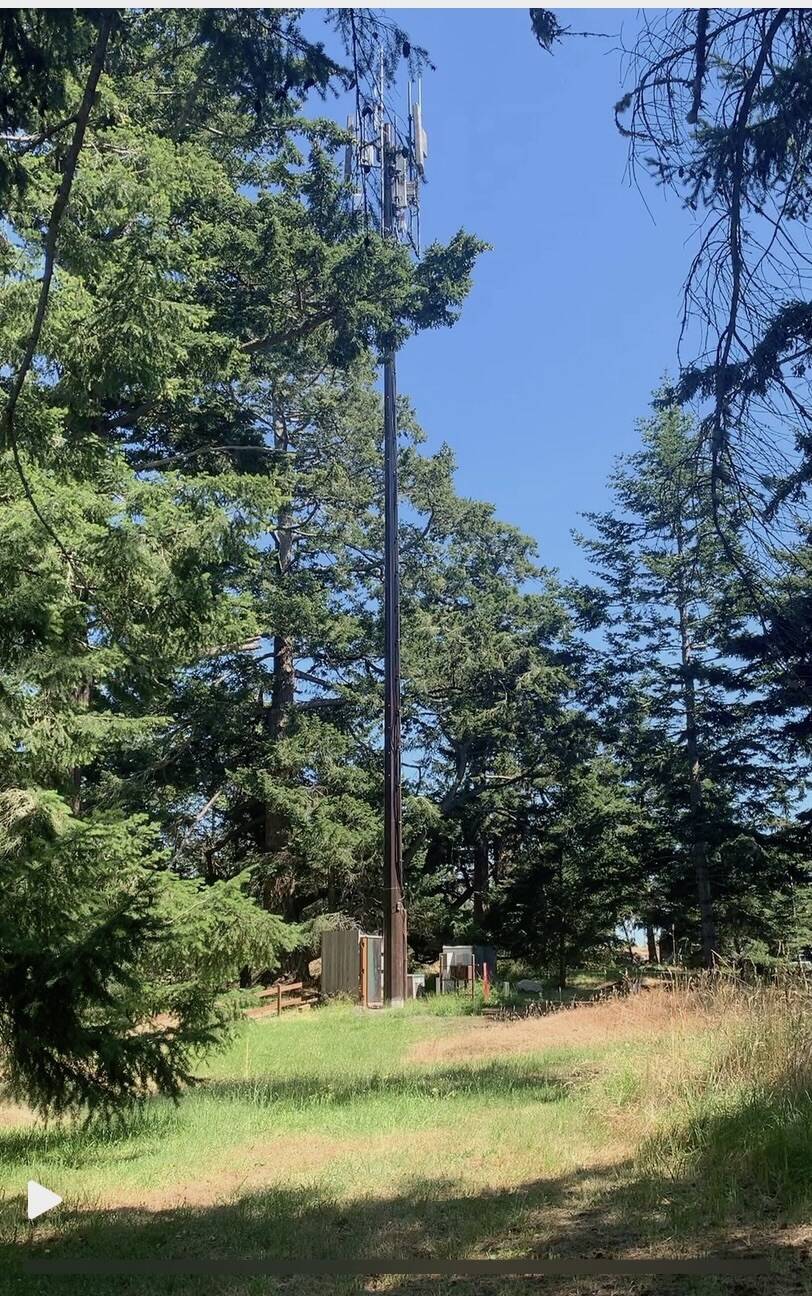
Contributed photo. Another angle of the tower with storage and generator.
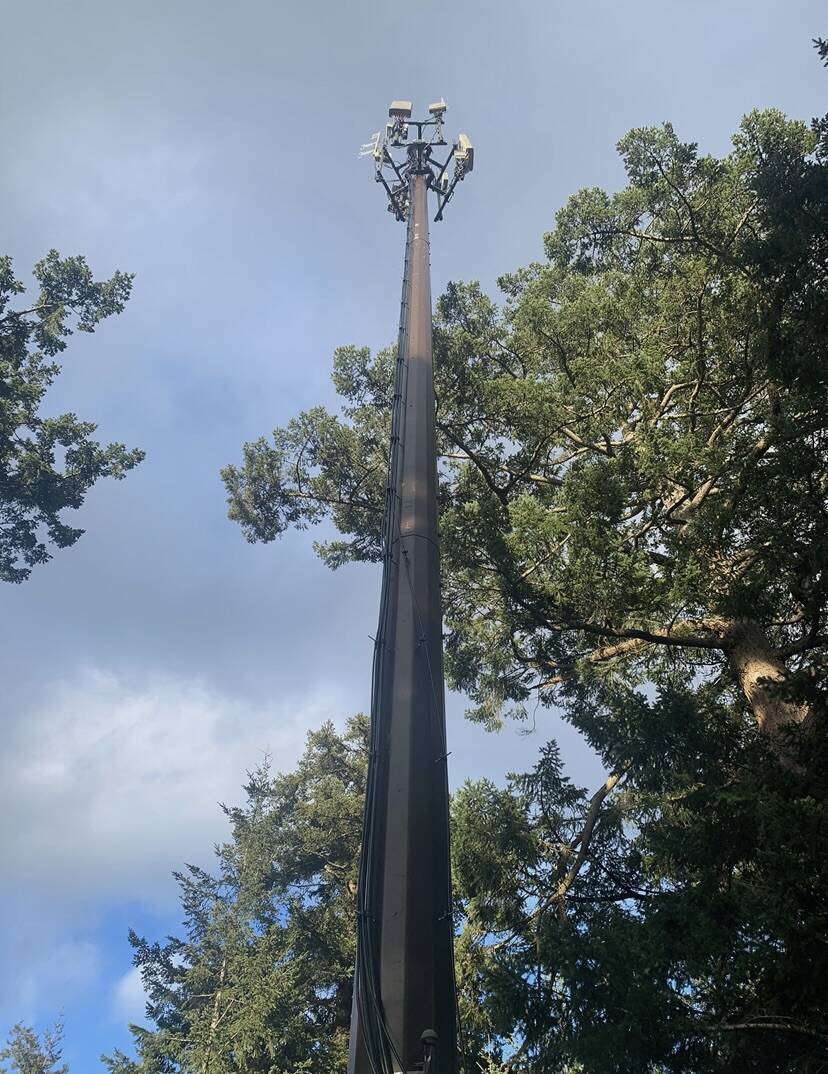
Contributed photo. Looking up at the new tower, 20 feet taller than the old one.