

By BOBBE NEEDHAM
Special to The Journal
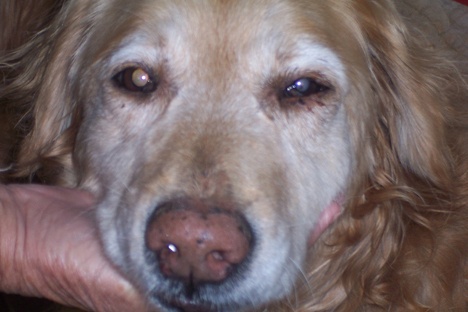
Until the wee hours of this morning, the only contact I’d had with our island’s fire department was peripheral — pancake breakfasts and visits to the Thrift Shop. But about 12:30 a.m., my golden retriever, Romeo, charged out of the house with his two canine companions, one leg in a sling and a cone on his head, the result of his being hit by a car five days ago.
Healing hip from dislocation, gash to the bone in one hock, cone on his head, pitch dark.
I followed the dogs out into the night in my pajamas and wool socks, no flashlight — why would I need one? They were in the backyard. But the backyard ends at an almost vertical hill that plunges to the water, and careening through bushes and around trees, Romeo became disoriented. What I heard was something crashing through bushes where there shouldn’t have been anyone crashing through anything — over the lip of the hill.
”I’m coming, Romy!” I called, picking my way down (dark, socks) until it was me crashing through bushes, and sliding, and then Romy’s body slamming into and over mine as he somersaulted farther down.
I could see his white face looking up and slid down to him. “We’re fine, Romy,” I reassured him (and myself) as I ripped the cone off. “We can do this, we’re fine.” A hundred feet to the top? Two hundred? (I’m not good with distances.) First I tried pushing him from behind, wedging myself between his rear end and a small tree trunk, forgetting his hip. He showed no interested in moving, sliding back down the few inches we managed.
OK. Try something else. I nearly strangled him trying to pull him up the hill by his collar. The collar slipped off. It took me five minutes in the dark to readjust it, tighter, but still no go.
Romy’s buddy Fergus, a West Highland terrier, had come down to investigate. “Romy fell,” I told him. “He might be hurt.” I yelled once for help, but why bother? My nearest neighbor was asleep, the neighbor on the other side out of town. I lay there in the dirt and leaves, holding Romy, trying to think. Also praying to everyone who came to mind.
“I have to go up without you,” I finally told Romy. “I can’t get you up.”
Crawling, grabbing onto branches that turned to mush in my hands, muttering, panting, trying not to think that I was deserting Romy. Twenty-five or 30 minutes later, I was dialing 911. The kind dispatcher at first misunderstood my frantic explanation. “How long has he been down there? Did he fall over a cliff? How old is your dad?”
“Not my dad, my dog, my dog.”
Her tone changed to one of regret. The fire department wasn’t really equipped for dog rescue.
How dangerous would this be for the men? (Just steep, not an actual cliff. But they would need lights. And rope.)
Might the dog come up by himself if we just waited? (Definitely not.)
She would see what kind of dog-rescue possibilities there were. She would call me back. More prayer. For Romy. For forgiveness from the Great Vet on high. To Buddha, Jesus, Allah, my dead grandmother, my sister who just died and left me her dogs.
She called back. The men were gathering, they were coming, they would be here soon. Thank you, thank you, whoever. I shucked my pajamas, got dressed. Sweatsuit. Shoes. I felt my way back out to the top of the drop-off. Forgot about a flashlight. “Romy, they’re coming. You’re going to be OK.” He couldn’t hear me, of course. He’s deaf. And old — 11 or so.
I heard the truck, the back-up beeps, went to meet it. Three (or maybe four) guardian angels dressed as firefighters. They said, “Good morning!” I said “Thank you, thank you so much for coming.” So inadequate. They attached lights to their helmets, draped coils of rope over their arms, carried big, bright lights, followed me through the trees and bushes and outdoor furniture. They consulted with each other. One angel tied the end of a rope around a pine trunk. “More are coming,” another told me. “Good,” I said.
“Where is he?” “I’m not exactly sure. Way down. Maybe to the right of that trunk.”
More angels gathered, at least eight in all. Men who had gotten out of bed in the middle of the night to rescue my dog. The chief, Steve Marler, introduced himself. The men went down hanging onto the rope. Then they called for more rope. More lights. A blanket. They disappeared down the slope. All I could see was the occasional beam of light playing across leaves, trunks, bushes. The men kept in touch via radio with the lieutenant in charge at the top.
The chief showed me the infrared (I think) image that could spot the heat of a body in the darkness. He passed it to one of the men, said to take extra batteries down just in case. Someone set up a huge light that he got going with the kind of pull starter I’ve only seen on lawnmowers and outboards. I felt the need to make conversation.
“Is there a particular kind of personality that’s attracted to do this work?” I asked the chief. I thought the answer would be something to do with an adventurous spirit.
“These guys are helpers,” the chief said. “This is the kind of guy who’ll stop and help you change your tire by the side of the road.”
Of course. Service. These volunteers were all about service. Three of them were assigned to the nearby Westside Road station, the chief told me. Most of the others to the Mullis Road station. The department got about 250 calls a year, but they came in spurts. The job was a big time commitment — ongoing training something like six nights a month on top of their basic training. Many of them were also EMT volunteers — even more time.
I went back to the house for a jacket and while I was there put Fergus on his leash. Maybe he could show the men where Romy was, once he got through barking at them. Big smiles on the chief’s and lieutenant’s faces.
“They found him. Dave’s making friends with him. Then they’ll bring him up.”
“Thank God. Thank you, thank you.”
Someone radioed up for a Stokes, which turned out to be one of those plastic stretchers. It took three or four men to guide it down, get it around trees, pass it along to the rescue crew that had gone into a huddle around my dog. Ten minutes later I could see him, gazing over the side of the Stokes, calm, interested, a sahib ignoring his bearers to take in the scene.
“Oh, thank you, thank you,” I said as the men reached the top, paused for breath and to let me stroke Romy, then carried him on into the house. They unstrapped him from the Stokes and he pushed himself up and limped into the next room to hide, leaving a trail of leaves and twigs and muddy paw prints. His hip didn’t seem to be a problem. Nothing seemed to be a problem.
One of the men went to the truck for cases of water. Shouldn’t I be serving coffee and doughnuts? I didn’t have coffee and doughnuts. They stood around in a circle at the top of the hill, drinking water, talking. Some took their jackets off. The helmets came off. They still looked like angels.
As they headed back to their trucks, one man said, “What time is it? I have to get up and go to work.” Just after 4. I repeated my mantra — “thank you, thank you” — a million times, “thank you so much, you’re my heroes.” It all sounded more inadequate than ever.
Fifteen minutes later, they were gone.
Thank you forever to Chief Steve Marler and the men and women whose big hearts lead them to serve as firefighters on our island. Thank you. Thank you.
— Bobbe Needham is a writer living on San Juan Island.