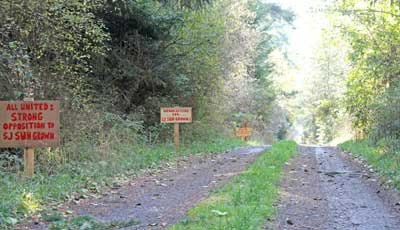
A lawsuit over use of a private road could leave a marijuana farm landlocked and without an avenue to get its product to market, if neighbors of the westside grow operation have their way.
Filed Oct. 9 in San Juan County Superior Court, the lawsuit contends a long-standing easement allowing shared use of a winding gravel road near the intersection of Mitchell Bay and West Valley roads also prohibits use of that road for access to “non-residential structures,” such as a commercial enterprise, like a farm.
The suit seeks an order to prohibit commercial use of the road and a halt to production of marijuana as well, until some other road access to the farm is available.
“I feel bullied by my neighbors,” said Jenny Rice, owner of Sweet Water Farm. “It feels like I’m being attacked all the time. It’s just been relentless.”
The contested use of Fieldstone Road is the latest in a series of legal entanglements facing Rice, who leases one acre of her 77-acre farm to brother David, owner and operator of Sun Grown San Juan. Rice and a partner began leasing the farm five years ago for a horse breeding business, where they also trained horses and offered riding lessons as well. She bought the property in 2012.
Permit under appeal, moratorium gains momentum
Neighbors are also contesting a decision by San Juan County that the Sun Grown San Juan operation will have no adverse environmental impact on the land, a so-called “determination of non-significance,” which means a project is deemed to comply with county land-use regulations and building codes. A ruling by the county hearing examiner is pending on the neighbors’ appeal of that DNS.
Meanwhile, the county council is considering imposing a six-month moratorium on accepting applications for land-use or building permits associated with marijuana production. The council’s discussion of a moratorium first began in mid-spring, in response to concerns raised by some islanders that cite a lack of regulatory restrictions on agricultural development in general, and on marijuana-related production in particular, including water use, traffic, security use of fertilizers and light pollution from greenhouses.
In a 2-1 decision, the council voted in late September to continue moving forward with the would-be moratorium, Council Chairman Rick Hughes cast the sole vote against it.
 If approved, the moratorium would first require review and recommendations by the planning commission, as well as another approval at a public hearing, before it could be imposed.
Friday Harbor attorney Carla Higginson, representing Rice in both the lawsuit over the road and SEPA appeal, doubts that the easement can be used to halt commercial use of Fieldstone Road or the production of marijuana, and believes that the neighbors behind the lawsuit are fundamentally opposed to the cultivation of marijuana, rather than for what purposes under which the road might be used.
Overlap in regulatory realm
For marijuana producers, processors and retailers, the path to regulatory approval is somewhat of a twisted, two-lane road. The Washington State Liquor Control Board holds sway over business licenses, while approval of whatever structure a marijuana operation may require or the impact it might have on the land rests with a local jurisdiction, such as a county or city.
San Juan Sun Grown received its state-issued business license about two months ago. It is one of four businesses licensed by the state to harvest marijuana in San Juan County, three of which are on San Juan Island.
Owner David Rice said the operation underwent rigorous inspection by the state, which included a criminal and financial background check, and must employ a number of state-required security measures, such as gates, fences, cameras and maintaining charts to track who comes and goes on the grounds, to satisfy a long list of Liquor Board rules.
In addition, Rice noted that a facility has to be constructed and in operation in order for the Liquor Board to have something to inspect, before a license can be granted.
Rice believed putting roots down on San Juan Island made sense. The business would create jobs, help stimulate and diversity the economy, and would be a money-maker, too. He didn’t expect to encounter such fierce opposition in a county where voters demonstrated such overwhelming support, at 68 percent, for Initiative 502.
“I thought it would be a good fit for San Juan Island,” he said, “and that there’d be community support for it. We could have done just about anywhere else, and probably cheaper too.”
Rice attorney Higginson believes the lawsuit over the road is not solely about business.
She said Sweet Water’s horse breeding business was well-known and drew no objection from neighbors over the years. The cultivation, production and harvest of marijuana seems to be a different matter, she said.
“There’s definitely another side to this case,” Higginson said. “SEPA (State Environmental Policy Act) is not a checklist about what neighbors do or don’t like. It’s a checklist about environmental standards, rules, regulations and impacts.”