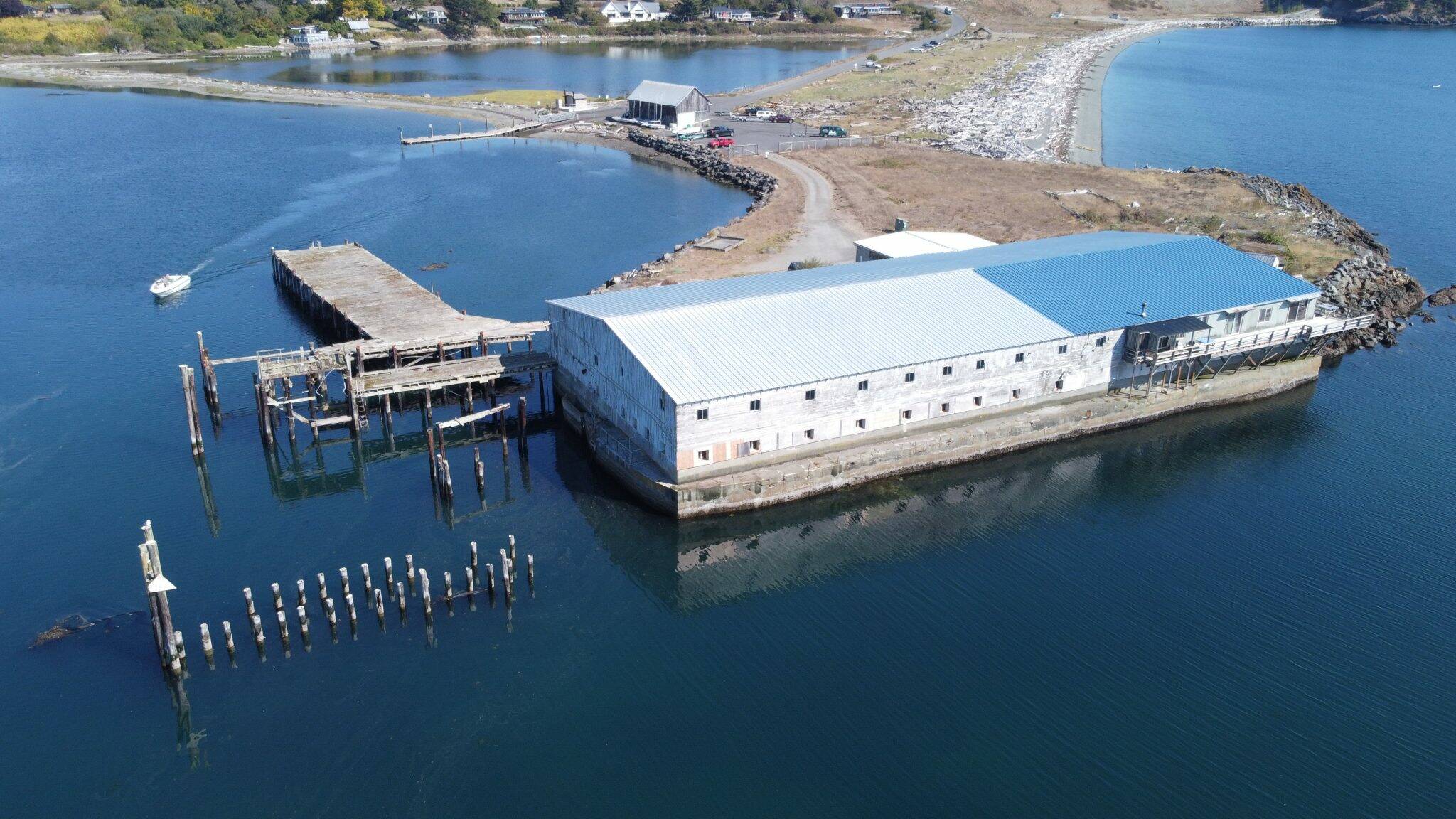
The Port of Friday Harbor Commission announced last week the purchase of the JJ Theodore Cannery building and the surrounding 2.12-acre parcel for $1.44 million. The over 20,000 square foot building, dock, and parcel sit at the western edge of Jackson Beach on Griffin Bay.
Todd Nicholson, Port Director, shared with the Journal more about the port’s goals and what needs to be done. The Port Commission will accept public input and try to balance (what they consider to be) the three most important objectives: create year-round living-wage jobs, provide public access to the waterfront, and protect and restore the environment.
They’re hoping to counterbalance the tourism-heavy economy on the island by creating a year-round, working waterfront. “When tourism drops off, it’s devastating to our economy,” Nicholson said. “We’d like to create jobs that are tourism-proof.”
Nicholson confirmed, however, that plans are currently wide open. “It kind of is a blank slate. You’ve got some limitations that can be worked around, some are tougher than others,” he acknowledged. “But, still, a ton of individual or multiple uses that could be done out there. The big next step is for the community and commission to talk through that in some workshops and come up with a plan. Then we will figure out the zoning/utilities for that plan.”
Zoning, or more accurately, comprehensive plan designations, will need to be altered. Currently, the parcel has two designations: one for the waterfront, which is presently classified as PMT, or Port Marinas Transportation, and one for the land, which is designated as rural residential.
“That’s the right zone for all of the types of port use. The trouble is the underlying land designation,” Nicholson explained. The current land designation of rural residential severely limits what can be done on that parcel. In order for almost any plan to move forward, that designation will need to be changed to either Rural Industrial or Commercial. That process takes around two years, at which point plans and permitting can start to move forward.
The Port issued a news release about the purchase on Sept. 16, which quickly garnered more than 150 comments on the What’s Up Friday Harbor group, many of which shared memories about the building, expressed excitement, or offered opinions about what should be done next.
“Great news, congratulations!” said Richard Civille in one comment. “That building is in great shape and perfectly situated for a wooden boat school, home port to a private charter service to Victoria inner harbor, an emergency dock if a ferry hits the landing in FH, and so much more.”
“This was my playground growing up. All the cannery ladies new [sic] me by name and were always so friendly,” shared Rich Jackson. “I would be thrilled to see it become a useful site in the future. Maybe it could remain as a marine/fishing sort of thing. Hats off to the Port of Friday Harbor.”
Other commenters were concerned about the potential mitigation costs.
“Everything’s rotten down there,” John Sandwith commented about the dock and pilings. “I wonder what it’s going to cost to get that all out – that could be two, three million dollars just for that.”
Nicholson addressed concerns about the clean-up and removal of derelict infrastructure and/or contamination by stating that these projects won’t impact either the budget or the timeline. Costs will be primarily covered by mitigation credits or Department of Ecology grants, and the work can be undertaken simultaneously while rezoning and planning are ongoing.
The septic situation, and to a lesser extent the water situation, are relatively significant barriers, however. The soil is shallow and rocky, and the entire lot is within 200ft of the water. Septic would be very difficult.
“Even the things you can’t do, given enough desire, you could make it happen,” Nicholson clarified. “You could have restrooms that pump to a vault and then pump that vault. Or you can bring in a containerized reverse osmosis sewer plant, or create a new sewer district for the port. There are solutions. Like in all things in the engineering world, almost anything is possible–at a price.”
Some options are less feasible than others, but Nicholson is excited to see what the public and port commission come up with together.
“Both the port staff and the commission are extremely excited about this whole project. We, as an organization, have been dreaming about all of the cool things we could do with that property to serve the public for decades. And now we finally have the opportunity,” he said. “There are so many great things that could be done on that property that would benefit the economy and benefit the public and provide additional waterfront access. There’s just all opportunity right now, and we are looking forward to getting in and working with the public to go through that planning process. I won’t get ahead of the commission or public on what it’s going to be, but I’m confident it’s going to be pretty dang cool and people are going to be happy that we did this.”