Born under a bad sign? Newborn joins population in throes of 30-year low
Published 5:59 pm Thursday, September 11, 2014
And, baby makes 79.
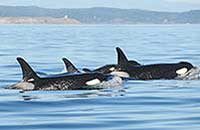
A two-year drought came to a welcomed end Saturday, Sept. 6, as researchers with the Center for Whale Research spotted a killer whale calf off the west side of San Juan Island.
Designated L-120 by the Center, keeper of the official yearly census of the Southern resident orcas, the calf is the first newborn to join the endangered population of killer whales since 2012.
While its appearance offers some relief from a prolonged, unusual absence of newborns, it comes at a time when the population, 79 orcas in all, has tumbled to its lowest mark in 30 years.
Center Director Ken Balcomb points to the lack of salmon, Chinook in particular, and to dwindling returns to the Fraser River of the orcas preferred prey as the primary reason for the population’s downward spiral. Two orcas went missing over the past year and are presumed dead, L-53, a 53-year-old female, and L-100, a male born in 2001, according to the Center.
“Poor Chinook years equal poor survival of whales, that’s the bottom line,” Balcomb said. “We’re not going to have these whales around if we’re not going to give them some fish.”
Listed endangered in the U.S. in 2005, the southern residents consist of three tightly knit clans, known as J, K and L pods. The population was declared endangered in the wake of a 20 percent decline in the mid 1990s. As of 2010, the population totaled 87 animals. The southern Residents also are designated endangered by Washington state and in Canada as well.
The newest member of L-pod, L-120, is the offspring of L-86, the third calf born to the 23-year-old female. She is mother of L-106, a 10-year-old male, and L-112, also known as Sootke, which died of injuries from an “unknown blunt trauma” in early 2012.
The death of the otherwise healthy 3-year-old led to a high-profile necropsy and speculation among many that its injuries may have been caused by naval ammunition training off the coast of Washington state, near the mouth of Juan de Fuca Strait.
Following the necropsy, the skeleton of L-112 was donated to the Friday Harbor Whale Museum, where it remains on display.
According to the National Marine Fisheries Service, the federal agency tasked with helping the population rebound, the primary threats to survival of the southern residents are lack of prey, pollution and disturbance from vessel traffic. The federal government spent $15.7 million on behalf of the Southern residents and efforts to revive the population between 2003 and 2012.
The plight of the population and its reproductive challenges (females of breeding age have fallen 20 percent and juvenile females by 21 percent since 2005), prompted renewed calls for greater protection from vessel traffic by Orca Relief.
The San Juan Island-based orca advocacy group has long-held that constant pressure from vessel traffic and whale-watch boats, in the summer months off the west side of San Juan Island in particular, causes greater stress on an already struggling population and interferes with the killer whales ability to find prey.
“Everyone concerned about these whale agree there should be more salmon for them to eat, but this could take 30 to 60 years–if ever–to achieve,” Orca Relief Executive Director Bruce Stedman said in a press release. “Only reducing the noise and disturbance from motorized boats can be achieved relatively easily, quickly, and inexpensively.”
Stedman said Orca Relief is committed to creating a whale protection zone off the west side of San Juan Island, similar to the so-called “No-Go Zone” proposed by NMFS several years ag, but with different management protocols. He said that as of last week, the group had collected roughly 800 signatures on a petition on its website in support of a protection zone.
“A whale protection zone is the achievable regulatory protection that would give us the best chance of saving this population from extinction, the outcome no one in Washington, or anywhere else, wants,” he said.