By Darrell Kirk
Staff reporter
The magic of Christmas on San Juan Island during the 1940s through 1960s arrived by boat from across the water, was delivered door-to-door by a beloved postmaster in a red suit and was celebrated with homemade divinity candy and Japanese oranges that appeared only once a year.
Three women who grew up on San Juan Island — Edie Heppler, Peggy Negley and Sonya Arend — share memories of a simpler time when the town’s postmaster moonlighted as the most convincing Santa Claus imaginable, and the entire community came together to ensure every child experienced the wonder of the season.
The Christmas ship
Every winter, anticipation would build among island children as word spread that the Christmas ship was coming — two of them, one from the Canadian Gulf Islands, the other from Bellingham, would travel through day and night, passing each other, sometimes meeting together for a short celebration. They would arrive in Friday Harbor decorated with lights and playing Christmas music, carrying the season’s most important passenger: Santa Claus.
“We would all go down to the waterfront and wait for the ship to dock, and it was always a big crowd, and I was always antsy for it to happen,” recalled Edie Heppler, who experienced the tradition in the late 1940s and early 1950s. “When the ship would come in, we would actually go onboard and meet Santa Claus and get candy and fruit. It was just a joyous, wonderful occasion witheverybody standing on the dock.”
100-year-old Sonya Arend, Edie Heppler’s mother, recalled the tradition from her own childhood: “There was always a ship that came down from Canada with Santa and singers, and families from Friday Harbor would go down to meet it. My dad played Santa Claus for the Friday Harbor community around the flagpole on Spring Street, and kids would get a little box with hard candy and a Japanese orange—the only orange we ever had all year.”
Peggy Negley, who remembers the Christmas ship from 1962 to 1967, described the magical moment: “As soon as the boat turned into the Harbor and you saw all the Christmas lights decorating it, and then heard the Christmas music playing, it was like, oh boy, you could hardly contain yourself. It was so fun.”
Even weather couldn’t dampen the excitement. Negley recalled one particularly memorable night: “I remember one time he even came in the fog. We were all waiting on the dock, and you couldn’t see anything. But as soon as that ship broke through the fog with all those Christmas lights, it was like, oh yeah, he really is coming.”
Santa Claus was the postmaster
The Christmas ship wasn’t the island’s only brush with Santa magic. In Friday Harbor, Santa Claus had a permanent address: the post office, where Walter Arend served as postmaster.
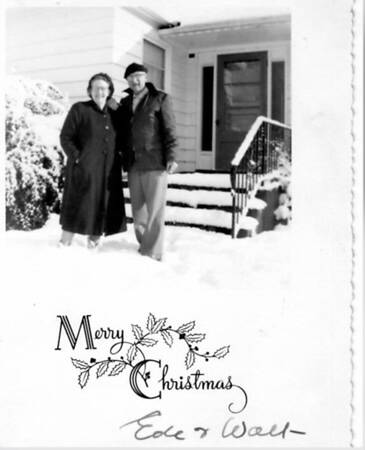
Walter Arend embodied the Christmas spirit so completely that his granddaughter Edie believed in Santa Claus until she was 10 years old. “On Christmas Eve, he would transform into Santa and visit homes on our block,” Edie recalled.
“My grandfather always dressed up as Santa Claus on Christmas Eve,” she added. “He would throw rocks on the rooftop [to simulate Santa and Reindeer], and he’d come in with a bag full of gifts and a ho-ho-ho throughout the house, and he played Santa for several families in our neighborhood.”
The performance was so convincing that Edie’s mother finally had to break the truth to her embarrassed daughter. “My mother finally told me one day … there is no Santa Claus. Your grandfather always played Santa Claus. And I argued with her. I said, ‘No, but he was there.’”
The secret to Walter’s success? “He would be in the room, and then he’d get up for whatever reason, and I didn’t notice that he was missing, and he’d come in, and he’d be Santa,” Edie explained.
He would go from house to house, collecting gifts that families had prepared, then delivering them to children throughout the neighborhood. The residents showed their appreciation: “They always left him a drink out there. By the time he got home, he was …” Sonya said, trailing off with a knowing smile.
Life in Friday Harbor at Christmas
Friday Harbor in the 1940s through 1960s was a working town where everybody knew everybody. “It was real simple,” Negley remembered. “There were wreaths on most of the light poles up and down main street. Different stores decorated their own windows.”
Sonya Arend’s memories of Christmas in Friday Harbor were filled with sensory details. “In my memory around Christmas time, we always had snow,” she recalled. “The tree was beautiful, lots of tinsel, and lots of those glassy kind of ornaments that we see now again, that are kind of made from metal and glass. The house was always filled with wonderful smells, and lots of laughter, lots and lots of laughter.”
Her grandmother’s house overlooked the town, with a Christmas tree “that touched the ceiling,” Sonya remembered. The island’s social life centered around various lodges — the Woodman Hall, Masonic Hall, the Moose, Oddfellows and the Legion — where families gathered for dances and celebrations. “Everybody that came to the dance or whatever brought food. And at 11 o’clock or something, they’d serve food to everybody that came,” Sonya said, describing the community gatherings that brought islanders together.
Shopping options were limited but personal. Rourke’s Dry Goods, run by local character Billy Rourke, carried fabric and clothes. Jerry Lawson’s store offered “hats and belts and basically a little bit of everything that you needed to get you through, because otherwise you’d have to go to the mainland shop,” Negley explained. The hardware stores — Marbles or Roberts — and King’s Market rounded out the commercial district.
Family traditions
Sonya Arend’s family meals were feasts of home-raised meat. “Mother always raised a goose. I hated those geese. They chased you, bit you,” she remembered. “But she raised that goose, and we had a goose for Christmas, a turkey at Thanksgiving.”
Peggy Negley’s mother baked constantly: “My mom used to bake a lot. We always had fresh homemade yeast rolls and she would make donuts or cinnamon rolls for breakfast, usually cinnamon rolls for Christmas morning. She made a bunch of different stuff, butterhorns, she’d make candy, fudge and divinity.”
Edie Heppler remembered similar traditions in her family: “In my family, there were a lot of family members. My grandmother was one of six sisters on the island, and my grandfather was one of five siblings, so there were lots of family and lots of family meals. Every year my grandmother made divinity, and every year she made fudge and all these wonderful foods and things that we didn’t have any other time of the year.”
Simple gifts
Gifts reflected economic realities while maintaining the spirit of giving. Sonya Arend received “a long pair of dark old socks along with handkerchiefs from my aunt.” Special years brought a trapeze set that she and her brother could put up in the tree in front of their house, a Monopoly game or a cherished dollhouse.
The tradition of including an orange in Christmas stockings persisted across all three families. “All my life, growing up with my mom, we always had an orange at the end of our stocking. Always,” Heppler said. “And Brazil nut.”
“The only orange I can ever remember having was that Japanese orange,” Sonya added.
A tradition worth remembering
Looking back, these women recognize something precious in those simpler celebrations. The Christmas ship has stopped making its rounds from Canada, and Walter Arend’s Santa performances ended decades ago. Friday Harbor has grown and changed.
But the essence of what made Christmas special remains in these memories. As Peggy Negley reflected: “I wish it would go back to simple days like that … that feeling of being home and being with friends and family and enjoying each other’s company and telling stories.”
In an era when Christmas often feels overwhelming, these stories remind us that magic doesn’t require extravagance. Sometimes all it takes is a decorated boat rounding the point, a convincing postmaster in a red suit and an orange that appears only once a year.
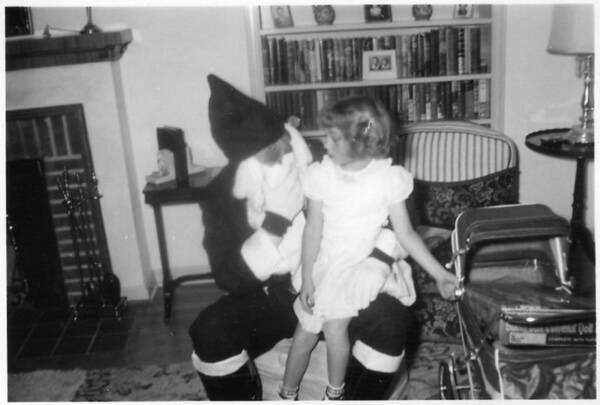
Contributed photo Edythe Heppler, with Santa Claus, her Grandfather, Walter A. Arend, who also was Santa Claus for many children in their neighborhood, delivering gifts, and rewarded with a beverage by grateful parents.
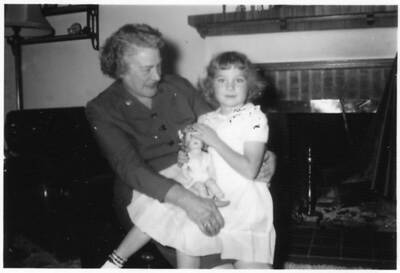
Contributed photo Edythe Heppler with her Grandmother, Edythe M. Perry Arend at Christmas.