Benefits of biochar
Published 1:30 am Tuesday, January 13, 2026
By Darell Kirk
Staff reporter
San Juan County landowners have a unique opportunity this winter to learn a centuries-old practice with modern applications: converting woody debris into biochar using low-emission kilns. The San Juan Islands Conservation District is offering free hands-on workshops on all three ferry-served islands, training participants to address two critical challenges facing the region — wildfire prevention and soil health.
The workshops will be held Jan. 25 at JB Farms on Orcas Island, Feb. 21 at Overmarsh Farm Commons on San Juan Island (now full) and Feb. 22 at Midnight’s Farm on Lopez Island. All sessions run from 10 a.m. to 3 p.m. and are limited to 15 participants per island.
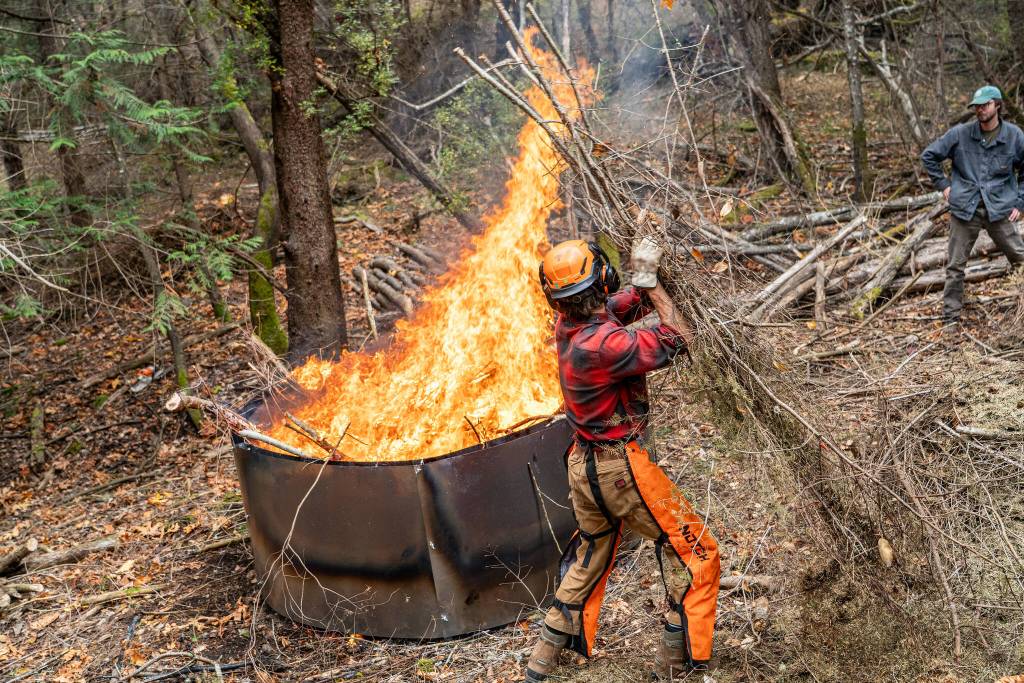
“One of the things about these kilns is they’re really only burning the small stuff,” explains Maggie Long, farm planner with the Conservation District and workshop instructor. “Those bigger logs aren’t a risk in terms of fire. It’s really that smaller, finer fuels that are the bigger concern.”
The timing couldn’t be more critical. Following last year’s wildland fire near West Sound on Orcas Island, island residents have gained a stark understanding of their vulnerability. The fire, though quickly contained, highlighted the dangers posed by overstocked forests that haven’t experienced regular burning in over a century.
Paul Andersson of the Conservation District emphasizes that the problem stems from fire suppression following European settlement. “Before settlers came to the islands, this area was burned consistently,” Andersson explained. “There used to be about 30 to 50 trees per acre. And now we’re seeing 300 to 500 trees per acre.”
The biochar kiln workshops offer a practical solution that serves multiple purposes. Participants will learn to safely process branches and small-diameter woody material — up to four to 6 inches — into biochar, a highly stable form of carbon that can remain in soil for hundreds to thousands of years.
The technique being taught has deep roots in indigenous land management. In an interview with the Islands’ Sounder, Steve Hinton, conservation scientist with the Tulalip Tribes’ Treaty Rights and Government Affairs Office, notes that biochar production “has been used for thousands of years by a variety of tribes throughout the continent and the world, really.”
“In the context, the modern context, we’ve been trying to revive cultural burning, which was a practice that was fairly pronounced through most of the tribal stewardship of these lands, especially out on the islands and across some of these Western Washington forests,” Hinton explained. Tribes would use low-intensity burning techniques to keep fields clear and hunting areas open while benefiting from the creation of biochar.
“I think what I’m most excited for is kind of breaking down this idea that biochar is this fancy product that we can’t make at home,” Long said. “Even just dousing your campfire, the charcoal that you have left over has so many of the same benefits.”
The workshops target two key audiences: forest landowners with overstocked stands and agricultural producers looking to improve soil health. However, the applications extend far beyond these groups.
“That could be ag producers, livestock owners. You can put biochar, mix it in with the bedding,” Long explained. “That’s a really easy way to kickstart the composting process. It can be applied to pastures, to row crops.”
Research conducted on San Juan Islands organic farms has demonstrated biochar’s remarkable benefits. Studies by Dr. Si Gao, Assistant Professor in the Department of Environmental Studies at California State University, Sacramento, showed that charged biochar — biochar pre-loaded with nutrients — increased soil carbon by 33% and boosted ammonium nitrogen by up to 45%. The amount of organic nitrogen that can be mineralized throughout the growing season increased to 110%.
The research also found that charged biochar reduced nitrate and phosphorus loss below the rooting zone by 28% and 46%, respectively, meaning more nutrients remain available for plants.
Beyond soil benefits, the kilns offer significant air quality improvements over traditional slash pile burning. “These kiln burns, because they restrict the airflow, they keep that flame cap on top, it burns off the extra particulate in the smoke and it burns super clean,” Long said.
This distinction recently led to kilns being classified separately from illegal barrel burning in Washington state. The clean burn is achieved by maintaining an active flame and extinguishing the fire with water before it reaches the ash stage, preserving the carbon-rich biochar.
“It’s nice to see it all part of the revival and thinking through techniques where we can keep it contained and safe in this modern context,” Hinton said of the mobile biochar kilns.
Hinton connects biochar production to broader principles of ecological stewardship. “It helps to take excess biomass and make something of it. There are a lot of beneficial uses of biochar. In some cases, what we’re advocating for is just leaving it [biochar] on the forest floor for forest health and water retention on the landscape.”
He describes biochar as “a circular economy, manifestation of a circular economy in so many different ways if done correctly. It’s a learning process that revives old ways and that’s exactly at the heart of the reciprocity recipe.”
This concept of reciprocity — of giving back to the land — runs counter to extraction-based approaches. “We’re not just burning slash piles, for example,” Hinton explained. “We’re actually giving back to the earth in some way with biochar, but also taking something that then helps us grow and kind of complete the circle.”
The Conservation District’s biochar work includes important collaboration with Coast Salish tribes. The Islands Conservation Corps has worked with the Samish field crew on conservation burns, and members of the Coast Salish Youth Coalition will attend the Orcas workshop.
“We’re involving the tribes in these because that’s what they had done for millennia,” Andersson said. Culturally prescribed burns have been conducted on Mount Grant in partnership with tribal members and the land bank, marking some of the first such burns in over a decade.
These partnerships reflect a commitment to co-stewardship rather than simple consultation. “It’s having them at the table early and often and throughout the whole process to hear what they want to do and why,” Andersson explained.
The Islands Conservation Corps crew recently participated in a tribal healing retreat with members of the Hiltzook tribe, a First Nations people from British Columbia, Canada, learning traditional cedar weaving techniques. “This crew of Conservation Corps members has been working in the forests here, seeing these culturally modified trees—the stripped cedar bark from trees in areas where they’re doing thinning, burning, and protection work. But they’ve never had the chance to tie the other end together and learn how to weave this traditional cedar bark into something of value,” Andersson noted, connecting their restoration work with traditional practices.
After completing the workshop, participants become eligible to rent the kilns from the Conservation District to use on their own properties. The district owns three “ring of fire” kilns and is launching this rental program to expand biochar production throughout the county.
Long brings extensive experience to the instruction. During her time with the Islands Conservation Corps, she burned hundreds of piles of woody debris from forest thinning and fuel reduction work, gathering data on biochar production from small-scale hand piles as an environmentally friendly alternative to traditional slash pile burning.
The workshops are grant-funded through the Washington State Conservation Commission’s Sustainable Farms and Fields program, making them free to participants. A suggested donation to the Youth Conservation Corps supports future environmental education programs.
Participants should bring long pants and long-sleeved shirts (avoiding synthetic materials), safety glasses, leather gloves, appropriate footwear, a bagged lunch and a K95 mask. Those wishing to take biochar home should bring a container.
To register for the remaining Orcas Island and Lopez Island workshops or to learn more, contact Maggie Long at Maggie@sjicd.org or 360-378-6621. For more information about the Conservation District’s wildfire prevention programs, visit sanjuanislandscd.org.