Center for Whale Research celebrates new L Pod calf during its 50th Anniversary year
Published 1:30 am Tuesday, June 23, 2026
Submitted by the Center for Whale Research
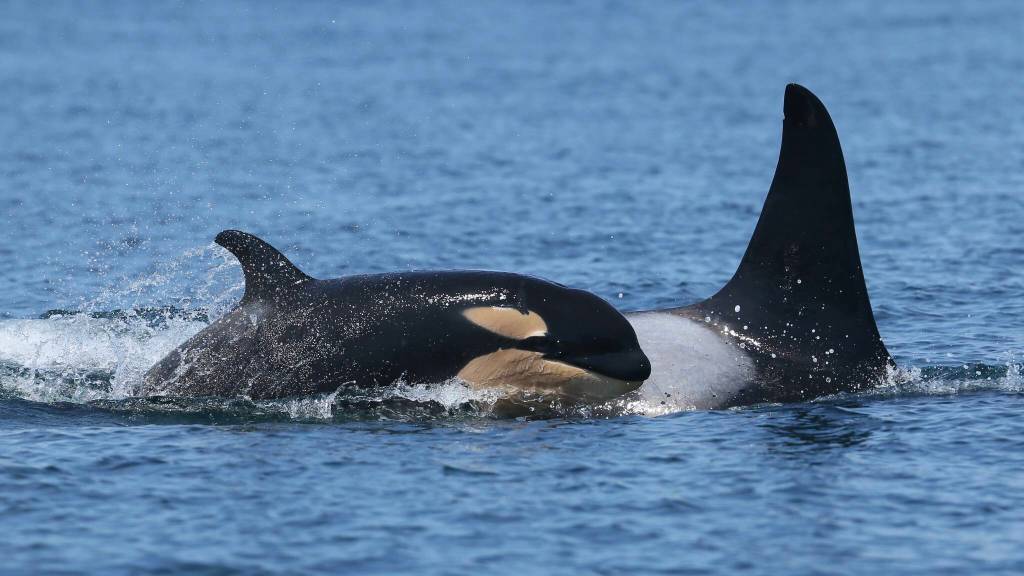
The Center for Whale Research is delighted to announce the birth of a new calf in L Pod of the endangered Southern Resident killer whale population.
The calf, designated L130, was observed by Center for Whale Research scientists on June 14 and 15 as members of J and L pods made their way in and out of the Salish Sea. L130 was primarily swimming with L91, but was also observed with reproductive females L83, L86, and L118, so more observations are needed to confirm the identity of the calf’s mother. Based on the calf’s size, behavior, and physical characteristics, it’s estimated to be between 1 and 3 months old.
The calf’s arrival comes during a particularly meaningful time for CWR as the organization marks its 50th anniversary. Since the launch of the Orca Survey in 1976, CWR researchers have conducted the longest continuous study of Southern Resident killer whales, documenting 151 births, 145 deaths, and tracking whales across four generations.
This long-term study has followed whales from birth through adulthood, parenthood, and even grandparenthood.
“Every calf matters,” said Darren Croft, Executive Director of the Center for Whale Research, “This birth is a reminder of both the resilience of these whales and the responsibility we all share to ensure their future.”
Each new calf represents a source of hope for the recovery of this endangered population.
However, the Southern Resident killer whale population remains critically endangered. “What we have learned over the last 50 years is that the future of Southern Resident killer whales is inseparable from the fate of Chinook salmon," said Croft. “Our long-term data show that when salmon are scarce, whales suffer. Recovery of this endangered population ultimately depends on restoring the populations of Chinook salmon on which they rely.”
The new calf represents the latest chapter in a remarkable record of continuity that spans half a century of scientific observation and conservation commitment. Yet the value of this moment extends beyond the birth itself. It reflects the importance of maintaining the long-term research program that allows us to understand how individual whales, families, and the population as a whole are faring over time.
“It is essential that this work continues,” said Michael Weiss, Research Director of the Center for Whale Research. “Effective conservation depends on long-term data. We need to monitor the health and survival of this calf and every whale in the population so that we can understand emerging threats and respond before population declines become irreversible. Without consistent monitoring, we cannot measure recovery, identify risks, or provide the scientific evidence needed to guide conservation decisions. The future of Southern Resident killer whales depends on maintaining this long-term commitment.”
As CWR celebrates its 50th anniversary throughout 2026, the organization will host a series of events honoring five decades of research and building support for the science, conservation, and stewardship needed to safeguard future generations of Southern Resident killer whales.
About the Center for Whale Research
Since 1976, the Center for Whale Research has been the leading organization monitoring and studying Southern Resident killer whales in their critical habitat: the Pacific Northwest's Salish Sea. CWR performs an annual census and regular health assessments of the orca population, informs government agencies of the whales’ ecosystem needs, shares their stories with the world, and promotes ecosystem recovery. Our 50 years of research have created the only long-term dataset documenting the Southern Residents' behavior, health, family relationships, and social dynamics.