Billie Swalla recognized with Lifetime Achievement Award
Published 1:30 am Monday, May 18, 2026

The University of Washington’s Friday Harbor Marine Labs was put on the map as their first female director and UW Professor Emerita of Biology, Dr. Billie Swalla, was recognized by the Society for Developmental Biology with the 2025 Lifetime Achievement Award.
“I was very surprised. I found out later that my previous post-doc and graduate students had gotten together and written letters nominating me,” Swalla said. “These are people who are now all over the world. It was very sweet.”
Former graduate student and mentee, Federico Brown, told the Society for Developmental Biology that “Billie’s disciplined attitude, rigorous lab routine, and tenacity in her daily research have positioned her as a leader in the evo-devo community.”
Her selection for the Lifetime Achievement Award, Society for Developmental Biology says in an article about Swalla, is a recognition not just of years of dedicated research, but of scientific courage — the willingness to study evolution and development — and encouraging others in the field along the way.
She joins an impressive list of scientists who have been recognized, including Eric Wieschaus and Christiane Nüsslein-Volhard. Wieschaus and Nüsslein-Volhard’s research on embryo genes led to a greater understanding of inherited birth defects and cancer in humans.
Originally from the Midwest, Swalla is one of the first in her family to obtain a doctorate. She stepped into her career at the University of Iowa, working on cartilage and muscle differentiation and limb patterning in chicken embryos, before studying embryology at the Marine Biological Laboratory in Woods Hole, Massachusetts. She was a single parent at the time, with a 3-year-old son.
“In 1983, I decided I wanted to go to Woods Hole, because they have these ascidian (sea squirts) eggs that have colored cytoplasms, and I was like ‘that is the secret to life!’” Swalla told the Journal. It was the first time she saw the ocean, and in that moment, Swalla’s passion for marine biology took hold.
The work at Woods Hole changed her life, eventually leading her to the Bodega Marine Lab at the University of California, Davis. Swalla began researching the molecular basis of development in tailed and tailless ascidians for her postdoctoral studies and later into the origins of chordates, including vertebrates. She began studying the molecular phylogenies of the deuterostomes, a worm-like creature in the early 1990s. Around 2000, Swalla proposed a new hypothesis that chordates stem from a worm-like ancestor. This hypothesis changed textbook theories about the origins of chordates. At first, no one could believe her new findings, Swalla said. At one lecture, a professor in the audience grew angry at her, simply because what they had learned years ago, and what they had been teaching, was suddenly called into question.
Around that same time, in 1999, Swalla arrived in Friday Harbor as a researcher and professor before becoming director from 2012 to 2019. She remains a full-time San Juan Island resident and active community member.
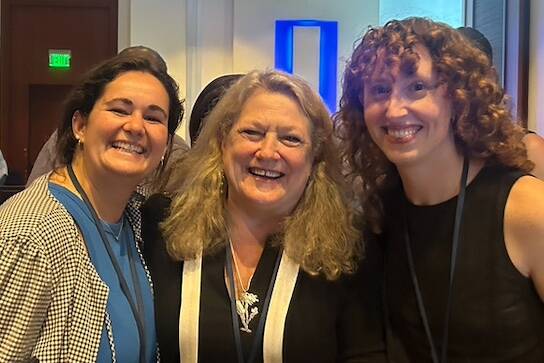
In June of 2025, Swalla attended the 20th International Congress of Developmental Biology held in Puerto Rico, where she gave a brief lecture about her work (https://www.youtube.com/watch?v=Wd6b4Q7WBjk) and was presented with her award. While addressing the Congress, Swalla thanked her graduate advisor Michael Solush, who taught her important lab ethics, like do the right experiment, always keep microscopes covered and always eat chocolate.
“I just fell in love with invertebrate embryos, I love working with them, I love being a scientist. This just feels right to me,” Swalla told the Journal. She is unfazed by the fact that the origins of chordates may never fully be known, saying, “I realized I like mysteries that we may never have the answer for.”