Decatur residents warn solar expansion sets precedent for all islands
Published 1:30 am Monday, February 9, 2026


By Darrell Kirk
staff reporter
George Lamb has watched the San Juan Islands change over his 56 years on Decatur. What concerns him most isn’t change itself — it’s the potential permanent scarring of what he calls one of the most beautiful places on earth.
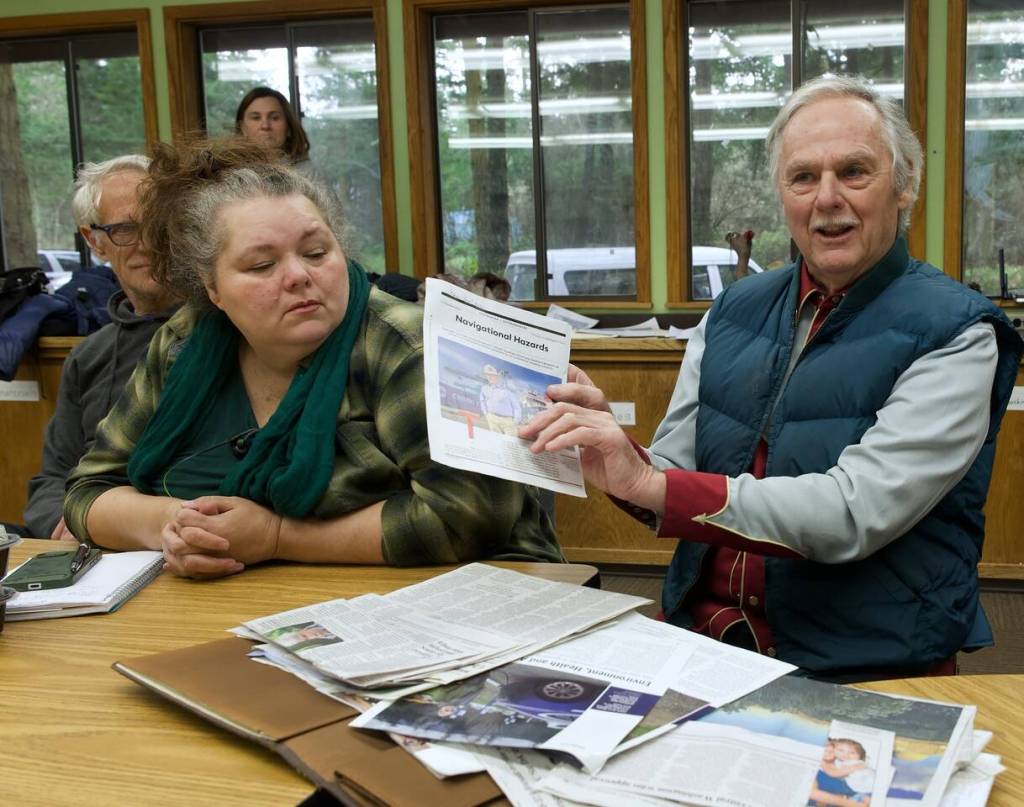
At a town hall meeting in the Karen Lamb Decatur School — the schoolhouse he built — Lamb addressed the gathering of concerned citizens.
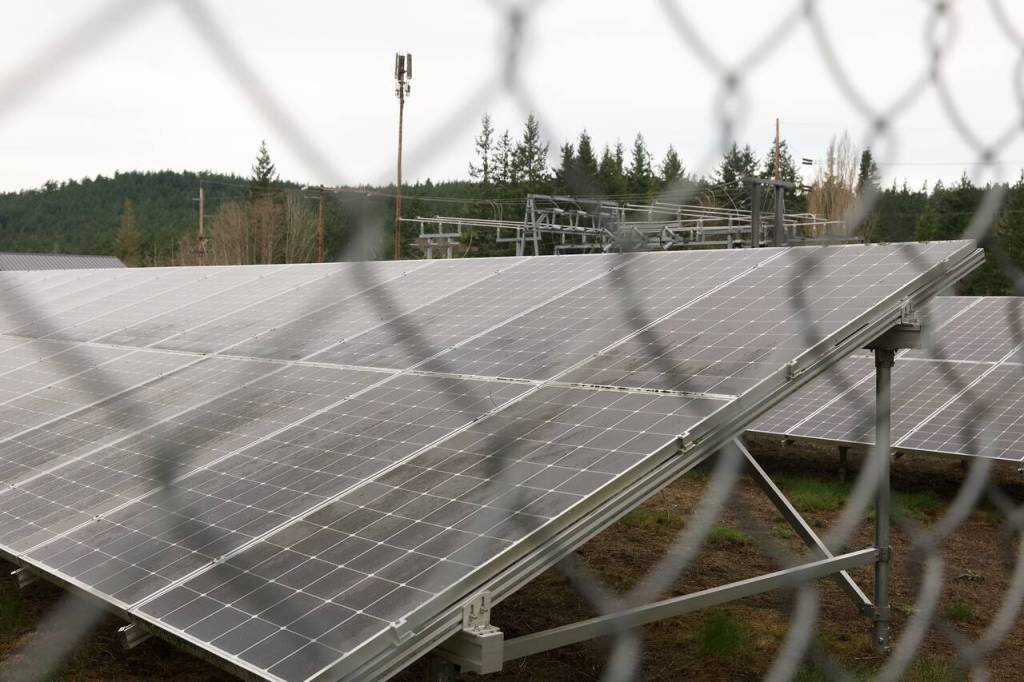
“We have a comp plan, and our comp plan calls for scenic roadways, new corridors, 200 foot setback from the water for building,” Lamb told a gathering of concerned citizens at the island’s schoolhouse. “[The San Juans are] supposed to be one of the most beautiful places on this planet. And this is something that you protect. Once you plaster over 875 acres of San Juan County with solar panels, which is just a form of industrial blight, and to ruin the beauty and the character of that really precious spot on this earth, to me, is unacceptable.”
This island community has spent the past year becoming experts in renewable energy policy. What began as OPALCO’s proposal to expand solar generation has evolved into what residents see as a preview for every island in the archipelago.
“I think we could be considered kind of the brain trust of solar power in the San Juans,” said Bill Hurley, a marine engineer who has analyzed the project. “Over this past 11 months, since this issue came up last March, we’ve become highly informed. We’re all really intelligent people, and we’re way ahead of the rest of the county in terms of understanding the issues.”
The controversy centers on OPALCO’s plan to expand solar generation after difficulties with a planned installation on Bailer Hill on San Juan Island. Many Decatur residents believe that they are getting this second solar array due to the public opposition to the San Juan project.
“They quietly purchased private property of about 21 acres right next to the microgrid [on Decatur] and they decided to roll this out in a little meeting with some of the people who had invested,” explained Kendra Lamb, George’s daughter. “They immediately got opposition.”
According to San Juan County’s Department of Community Development, the project requires a conditional use permit for commercial power generation on two Rural General Use parcels.
According to OPALCO, they are: “committed to serving OPALCO members with reliable power while maintaining high environmental standards throughout the life of this project. Per discussions with San Juan County, the proposed project is required to undergo a Conditional Use Permit process. This entails an administrative review of the application of San Juan County Code and State Environmental Protection Act review. Additionally, the project will undergo a National Environmental Protection Act review.”
Many residents are invested in the existing array but feel their concerns and alternative solutions are being dismissed.
Rob Grant addressed this directly: “I think you need to be aware that the way OPALCO will position the people on Decatur is kind of the lowest common denominator. They’re gonna say that we’re just a bunch of NIMBY tree huggers over here. We’re not country bumpkins. We’ve got some really intelligent people who have backgrounds in this area.”
He continued, “We’re asking intelligent questions and we are bringing up valid points. The problem is they don’t like the questions and they don’t like the points that we’re bringing up.”
Environmental Support and Alternative Sites
Friends of the San Juans staff toured the proposed sites during another town hall with Decatur residents on Jan. 22, expressing reservations and noting the importance of preserving tree canopy, soil health, and extensive salal. They advocate that commercial solar prioritize existing impervious surfaces or already cleared lands rather than removing healthy forests.
In a document prepared by Hurley detailing that town hall conversation, Friends discussed that “they had worked with OPALCO over the past two years, spending hundreds of hours negotiating criteria for responsible solar siting. Additionally, Friends successfully brought docket requests to the Planning Commission and County Council to open up more appropriate sites for the placement of commercial arrays to not impinge on natural resource lands such as farms, forests, wetlands, etc.”
In the same document, Friends stated that “Bilateral discussions between Friends and OPALCO stalled after OPALCO decided to pursue designation for commercial renewable facilities as Essential Public Facilities within the Comprehensive Plan. The County Council approved the Comp Plan and included renewable energy projects, citing the county as ‘essential.’”
Per OPALCO project documents: “About eight acres of the site will be cleared of trees. The forest has been logged several times, with many young or moderate-sized trees. There is a mix of fallen trees from wind damage and signs of tree root disease. The remaining area will be wetland protection and setback areas. We will install code-compliant landscaping barriers to make the view from the road aesthetically pleasing.”
Residents emphasized the project should be an all-county discussion. “The Decatur project and implementation of solar arrays throughout the County should be an all-county discussion,” said Roz Soloman, noting it is not equitable to install another array on Decatur when all islands need to do their part.
According to OPALCO: “Decatur is a logical location because OPALCO already has an existing solar site and substation on OPALCO-owned property. OPALCO remains committed to the cooperative principles which emphasize fairness as a key tenet, so we are not asking Decatur to shoulder more of this burden – the potential solar OPALCO is still less than the expected load growth on Decatur. In addition, OPALCO plans to site microgrids throughout San Juan County.”
Krista Bouchey, OPALCO’s Manager of Communications, elaborated on the cooperative’s plans: “OPALCO has analyzed our various options and ways to meet the expected electrical load growth in San Juan County as dictated by the Comprehensive Plan. There isn’t one perfect number of sites or options here and the Board will be constantly analyzing and reviewing ways to continue serving San Juan County with reliable power as the regional power supply becomes more precarious. OPALCO would like to see microgrids on each of the major islands near the population centers to offer backup power should the need arise but since infrastructure costs are rising and there is a lack of grant funding, future projects may be more difficult to fund. For now, we are focusing on Decatur and then we will restart the Bailer Hill agri-solar project.”
The most significant frustration involves OPALCO’s treatment of alternative sites. Residents proposed locations requiring no forest clearing, including cleared easements under Bonneville Power Administration lines.
“We have an alternative site, clearly close to the existing array, and close to their substation, that would work,” Grant emphasized. “If you are hell-bent on putting this on Decatur, and you’re not going to take no for an answer, then at least give serious consideration to this alternative site that is right over here, that is already cleared, has full exposure all the time, is not an eyesore, and there’s not a massive forest that’s going to be cleared.”
Dawn Cunnington offered her own property: “I am personally willing to go the distance on this issue. One solution I have offered is my own property, which is already encumbered by a Bonneville Power Administration easement. The site is close to an existing substation and has been intentionally maintained as a cleared area for decades. I did the calculation on it, and it’s at least nine acres because the Bonneville easement is 100 feet wide, then it runs all the way up the hill before it turns a corner and then runs out to the old mail dock.”
Yet according to community members, OPALCO’s response has been inadequate. “They said that they emailed George, but he doesn’t even have email,” Cunnington noted. “They also said that I didn’t respond, and I did.”
“When we are countered in a way that’s going to facilitate emotional responses, we stay focused and say, thank you. Now, please answer the question,” said Soloman.
“They’re doing everything in their power to fight against what we want,” said Kendra. “They cry, I’m a co-op. It’s like they’re doing everything in their power to fight against what we want, and we already told them.”
Kendra noted the contrast: “I talk with public works sometimes. I talk with our elected county officials sometimes, all of that. And it is an entirely different situation than OPALCO. It is very hard to get a direct answer. You have to reiterate and rephrase the question.”
Jill Rullkoetter elaborated on the frustration: “It’s insulting to interact with a membership organization when we are the members and they’re not listening to us. I’ve worked with nonprofit membership organizations my whole life, and you always listen to your members—you don’t push them aside. It’s frustrating to see people trying to express their concerns and OPALCO just doesn’t want to listen.”
Despite frustrations with OPALCO leadership, residents emphasized their positive relationship with the OPALCO crews who maintain the Decatur facilities, distinguishing between management decisions and the workers they interact with regularly.
Residents have substantive concerns about the project’s viability, including what they believe is outdated panel technology potentially dating to 2017, cost-effectiveness for less than 1% of the county’s energy needs, and the unsuitability of solar power west of the Cascades.
In previous correspondence with the Journal, Hurley elaborated on the economic concerns: “Commercial developers would never, aren’t coming to Western Washington to build solar farms because it’s not economical. If a commercial developer’s not gonna do it, it doesn’t make sense.”
Beyond economic concerns, residents emphasize Decatur’s unique infrastructure limitations. “There is only one ramp to accommodate all roll-on roll-off vehicles and equipment on and off the island,” Hurley noted. “Decatur is not a ferry-served island, hence access is expensive and limited. Decatur does not have a fire district. There are no paved roads or infrastructure to support the installation activities.”
Alternative Technologies Overlooked
The opposition has evolved into a critique of regional energy planning. Residents argue OPALCO should develop a comprehensive strategy rather than pursuing piecemeal projects.
“We need to look at everything,” said Soloman. “We need to look at what the real cost of another cable is. What’s the real impact? What is BPA really going to do or not do? What are the actual growth projections for this county? What are the best energy generators for this area that is west of the Cascades, where no one else is building solar?”
Residents see their struggle extending far beyond Decatur’s 2,240 acres — as a preview for every island in the county.
“I think people of the San Juans need to understand that if this goes through here, it will only be a matter of time before it’s in your backyard and you will deal with it,” said Grant. “If you don’t assist us in this situation, it will affect you down the line.”
The message to other islands is clear: Ask questions, demand real answers, and don’t be dismissed. “Don’t take their answers at face value,” said Hurley. “Question their answers. Asking questions will just lead to more questions and then they’ll keep people educated like we have.”