Comp Plan approved without Roche Harbor
Published 1:30 am Tuesday, December 16, 2025
By Darrell Kirk
Journal contributor
The San Juan County Council unanimously approved the 2025 Comprehensive Plan periodic update on Tuesday while separately rejecting a controversial proposal to expand the Roche Harbor Master Plan Resort.
The Council voted to remove the Roche Harbor amendment from the Comprehensive Plan after determining the resort had failed to provide binding commitments on affordable housing. The modified Comprehensive Plan was then adopted, with the Roche Harbor proposal excluded.
Comprehensive Plan approved
The approved Comprehensive Plan includes several significant elements required by the state’s Growth Management Act:
The plan designates utility-scale renewable energy generation and storage facilities as Essential Public Facilities, a move intended to address the County’s energy security concerns and reduce regulatory barriers for projects like those proposed by OPALCO. Council member Justin Paulsen provided a vivid explanation: “We have an extension cord to the mainland, and it has a capacity. And at some point, that capacity is going to be overtaxed. And what happens when you overtax an extension cord is it explodes. And now you have nothing.”
Council members emphasized that rigorous public engagement and environmental standards would still apply to any such projects. The plan also expands the East Sound Urban Growth Area to include two parcels (Areas A and B) along Bartell Road to accommodate affordable housing needs. Paulsen noted this addresses a demonstrated housing capacity gap, while residents raised concerns about traffic impacts on North Beach Road.
Orcas Island resident Patricia Miller said, “The county is depositing 100% of its Urban Growth Area expansion onto a single road, North Beach Road, and almost all onto one landowner, OPAL, all while failing to do any sort of meaningful transportation analysis on its impact.”
Barb Scotty, also a resident of Orcas Island, added that the expansion areas “would increase the traffic by upwards of adding 180 plus units. We’d be going from an area that is currently zoned R5, that is one unit per five acres, to potentially 12 units per acre, a 60 times increase.”
The plan responds to state mandates by documenting the County’s $6 million annual affordable housing funding gap and identifying obstacles to development, including unclear regulations and parking requirements that need reform.
Roche Harbor proposal rejected
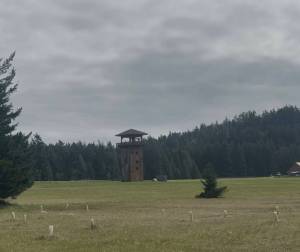
The Roche Harbor proposal sought to add 119 acres of rural land to the existing 158-acre resort, relocating 180 housing units that cannot be built on the original property due to wetland constraints.
Council chair Kari McVeigh said specific affordable housing commitments evaporated just before the vote, creating “a real level of distrust.” She had been told for months that the project would include 48 manufactured homes, with half for Roche Harbor workforce housing and half for community members at 20% below market rates.
“At the 11th hour, that was rescinded to ‘we will collaborate with you,’” McVeigh said. “They told me what they wanted to do, reiterated those same plans to me personally the day before our council meeting, and then it all evaporated.”
The expansion stems from newly discovered wetland constraints on property established in 1996. Roche Harbor General Manager Matthew Allen testified that critical area reviews revealed both the proposed housing sites and utility infrastructure corridors were wetland-impacted, making the original site too constrained for development.
Paulsen explained that scientific standards have changed dramatically since 1996. “Buffer limitations have changed. The habitat buffer, which wasn’t even a thing that we discussed in previous wetland studies, is now part of that calculation,” Paulsen said. Roche Harbor agreed to remove golf courses as an allowed use across the entire 277-acre property, addressing community concerns about water usage and chemical impacts. Patrick Daugherty of Bellevue Farms urged the Council not to “take at all lightly the notion of rezoning rural land,” noting current zoning supports small-scale agriculture.
Despite the rejection, Council members expressed willingness to reconsider a better-developed proposal. “This is not about punishment at all,” McVeigh said. “This is about being really honest, straightforward.”