Public testimony reveals deep community divisions over Griffin Bay development
Published 1:30 am Monday, November 3, 2025


By Darrell Kirk
Journal contributor
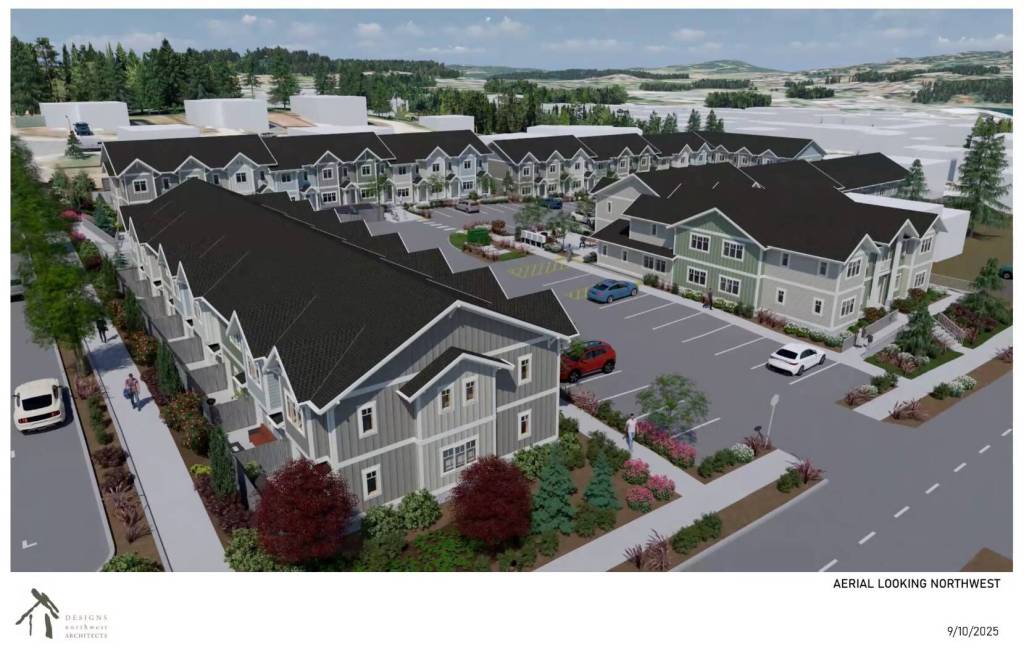
The Friday Harbor Town Council heard impassioned testimony from residents during an Oct. 16 public hearing on the proposed Griffin Bay development, a 49-unit residential project planned for Hamilton Ranch Road across from the elementary school.
The developer is seeking significant waivers from existing Town codes to build the multifamily complex on a 2.11-acre site. In exchange for the density bonus, the developer has committed to providing eight units of permanent workforce housing for households earning 80% of area median income, along with frontage improvements on Hamilton Ranch Road and Grover Street.
David and Laura Flaum, managing members of Favor 3-4 LLC, presented the draft development agreement with architect Kim Williams, who outlined the project’s vision to “create middle housing, residences that are affordable and available to the workforce of Friday Harbor” designed as “a village of residences that compliment the pedestrian and neighborhood character” while “honoring historic standards.” However, residents living near the proposed site raised urgent concerns about traffic safety, parking overflow and impacts on neighborhood character during the meeting. Flaum emphasized the team’s extensive experience in such projects.
Safety near elementary school dominates testimony
The proximity to Friday Harbor Elementary School emerged as residents’ primary concern, with multiple speakers describing already dangerous conditions that they fear will worsen dramatically.
Amber Harshbarger, who lives in the Homestead Islander development directly across from the school, described how parking and traffic have deteriorated since she moved there in 2015. “During our first two or three years in the neighborhood, virtually no one parked in our area to drop off their children at school,” she told the Council. “Now, with all the developments built down the road from us, it’s absolutely insane how many people come into our neighborhood to park, including right in front of people’s driveways.”
Despite living within easy walking distance of the school, Harshbarger said she now drives her nearly 3-year-old daughter to school because she considers the pedestrian route too dangerous. “I’ve nearly hit a child who literally ran out without using the crosswalk, because so many cars are parked along our mailbox area,” she said.
Rachel Stephens, who lives on Gerard Lane directly behind the proposed development, echoed these safety concerns. “Even though I live on Gerard Lane and could easily walk to the school, I choose not to because it’s so dangerous,” Stephens said. “Cars are parked behind other cars, so there’s a parking spot with another vehicle blocking it. You can barely reach the road. Cars are backing out everywhere.”
Stephens argued the project contradicts the Town’s Comprehensive Plan: “The comprehensive plan clearly states that growth must be managed within the urban growth area in a manner consistent with existing neighborhood character. Any development that increases congestion, alters traffic flow, or reduces pedestrian safety within established residential and school areas conflicts with these goals.”
Justin Hewitt-Platts, a resident of the Heritage Court neighborhood, expressed support for high-density housing in principle but emphasized the need for adequate infrastructure. He urged the Council to consider traffic calming measures and crosswalk improvements along Grover Street, particularly near the elementary school. “We need to make sure that additional traffic does not put the lives of children at risk,” Hewitt-Platts said, noting that he and his neighbors, including children, have already had to evade speeding vehicles in the area.
Affordable housing guarantees questioned
While supporters acknowledge the need for workforce housing, several residents challenged whether the project adequately addresses that need.
Amanda Lynn, executive director of the San Juan Community Home Trust, questioned the lack of enforcement mechanisms for the eight designated affordable units. “The development agreement currently requires rents on these units to be capped at 30% of income for households earning 80% of area median income, which sounds promising in theory,” Lynn said. “But my question is: who will ensure rents are actually set at those rates? Who will verify income qualifications?”
Lynn argued that eight affordable units out of 49 total — representing just 16% — were insufficient given the density bonus being granted. “We have a proven mechanism for building 100% affordable housing projects: community land trusts,” she said. “We have one right here, and we should use it.”
Morrell supported affordable housing in principle but not this proposal: “I can 100% support the need for affordable housing—but eight units in a 49-unit complex is not the answer. Especially when we cannot guarantee, one, that it will stay that way, and two, that the people living there will meet those income requirements.”
Council debates unit mix and long-term housing needs
The Town Council engaged in detailed discussion about the composition of units, particularly the balance between one-bedroom and two-bedroom apartments.
Councilmember Anna Maria de Freitas expressed concern about allowing too much developer flexibility. “I mean, I think we’re all looking at this as our one opportunity in town to really build true affordable housing. And we wanna maximize density as much as we can and maximize the investment,” she said. “And if we kind of keep on giving more and more flexibility, then we may only get 10 units and that’s probably not gonna be the case, but this is our one opportunity and I don’t think we wanna squander it.”
Council debated demographic considerations and the need for two-bedroom units, with some members noting concerns about single-parent families potentially crowding into one-bedroom units, creating substandard housing conditions, while others argued that bedroom requirements help maximize occupancy and density.
Parking concerns and infrastructure limitations
The proposed parking ratio of 1.5 spaces per unit drew sharp criticism from multiple residents who argued it fails to reflect the reality of island living.
“The parking issue is almost amusing because those of us living here know that most households with more than one person have more than one car,” said Suzanne Bryner, who lives on nearby Argyle Street. “Working on this island means being able to get around the island—jobs are all over. I travel from one end of the island to the other for my work, and if someone else lived in my house, there’s no way we could manage with one or one-and-a-half cars.”
Corinne Morrell, who lives at the end of Hamilton Ranch Road directly behind the proposed development, noted that overflow parking already causes problems during school events. “Consider fair events, games, and activities that happen on school grounds on weekends: it’s already congested for parking and has caused problems,” Morrell said.
David Day, a business owner living next to the site, characterized the parking provision as creating “predictable and unpredictable issues,” noting that Hamilton Ranch Road is a one-way cul-de-sac with a single exit point.
Jennifer Hill-Girard encouraged councilmembers to visit the site before voting on the proposal. “I would encourage every council person who is going to be voting on this to please come out and visit and walk that lot and that area of land,” Hill-Girard said. “I don’t think the slides would be so impressive if you see the reality. I think you’ll be about as confused as I am about how those parking lots are going to fit—the square footage doesn’t seem to be aligning with the reality I’ve walked.”
State mandates drive local development decisions
Town Administrator Denice Kulseth elaborated on the state’s increasing control over local planning decisions, particularly regarding parking requirements. She explained that during the legislative session, she had “frantically” written to state representatives about Senate Bill 5184, which sought to eliminate parking requirements for most development. Kulseth and others on the Council stressed that many planning decisions are now being made by the state, and are out of their hands. Due to Kulseth and others’ efforts, Friday Harbor was able to continue to keep existing parking guidelines in place.
Calls for broader affordable housing policy
The Griffin Bay hearing comes amid broader discussions about the Town’s approach to affordable housing. In an Oct. 15 guest column in The Journal of the San Juans, Amanda Lynn (executive director) and Paul Fischburg (board president) of the San Juan Community Home Trust outlined actions a mayor supportive of affordable housing could take, including appointing an official Town Council representative to the San Juan County Housing Advisory Committee, and adopting a permanently affordable housing ordinance to establish clear policies rather than negotiating individual development agreements for each project.
Every housing unit requires infrastructure
In a follow-up interview with The Journal of the San Juans, Lynn emphasized the finite nature of island resources. “Every time you add a housing unit on this island, that requires infrastructure, that requires community resources like fire, police, school, anything you can think of,” Lynn explained. “Every housing unit requires these things. So there’s always a balance beyond even just thinking about the ecosystem balance of the island itself.”
Limited resources, limited land
The concern extends far beyond just the physical footprint of buildings. “We’re not just talking about land and some traffic,” Lynn stressed. “We’re talking about the sewage, water, police, all of those resources needed per person. And just the carbon footprint, the impact on the shoreline, the impact on the Salish Sea and the boats, the ferries, the reservations – everything.”
In a town that doesn’t charge impact fees, these community costs are absorbed without compensation. Lynn pointed out that the developer would be receiving “both a profit, additional profit margin, and our community resources to a private developer for supposedly eight units when they could just as easily grant that density bonus to another developer willing to put permanent deed restrictions on those units.”
Quality of life vs. high-density
Suzanne Bryner raised concerns about livability and quality of life in high-density developments. “We’re building places that have no open space for people, for kids, for pets,” Bryner said. “We’re not building places where families can have longevity—where they can get a dog and have a small yard and have pets that feel safe.” Bryner continued, “I also want to say that any time we are considering a project meant to alleviate the cost of living and make housing affordable, I think we should be working with the organization we already have in place. The Home Trust has been doing this—this is what they do, and they’re part of this community.”
Project details
Griffin Place is a multifamily residential development proposed by Favor 34, LLC and Griffin Place LLC (David and Laura Flaum) with Designs Northwest Architects as the agent. Located at 719 and 747 Hamilton Ranch Road at the northwest corner of Grover Street E and Hamilton Ranch Road, the 2.11-acre site (APNs 351391436000 and 351391437000) is zoned MF Multi-Family and will feature 49 rental residences comprising eight apartment flats and 41 townhomes with a total of 91 sleeping rooms, including eight workforce housing units (five flats and three townhomes). The development will have a total building area of 53,982 gross square feet with setbacks of 20 feet minimum from the private road frontage, 15 feet total on sides (5 feet minimum each side, 10 feet at Grover Street), and 5 feet minimum from the rear property line.