Peace Corps volunteers return to Friday Harbor: A 57-Year journey of impact and legacy
Published 1:30 am Thursday, September 18, 2025

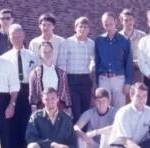
In July 1968, seventy-two young Americans volunteered for a rigorous training program at the University of Washington (UW), preparing them to serve as Volunteers in the US Peace Corps mission to Chile. This group was an important experiment in the early days of the Peace Corps, in that they were chosen due to their education, training, and expertise in two specific technical fields – Fisheries and Forestry. Before 1968, Peace Corps volunteers were selected from generalists, but this group was a test of whether it might be helpful to select volunteers who already had some education and training in specific fields of expertise. Of the 72 Volunteers in this group, 23 had previous education in Fisheries Biology and 48 in Forestry and related fields. The Fisheries Volunteers then received targeted additional training
provided by UW Fisheries professors on the main UW
campus, and also trained at the Friday Harbor Marine Lab
— a place that would remain etched in their memories for
a lifetime. The Forestry volunteers had similar, targeted
training provided by UW Forestry professors. Now, nearly
six decades later, this tight-knit group, known as Chile 68,
will reunite once again — this time at Friday Harbor, WA
for a reunion during September 15-19, 2025.
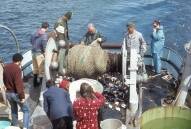
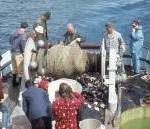
Chile 68 Volunteers on UW Trawler
Their return is not only nostalgic – it is a celebration of the enduring legacy of the Peace Corps and the transformative power of applied academic training. The reunion allows the group to pay tribute to many legendary UW fisheries pioneers — Drs. Lauren Donaldson, Allen DeLacy, Earnest Salo, John Liston, Ken Chew, Izadore Barrett, Pat Tomlinson, and many others — who guided the volunteers during those formative years. Some UW professors like Dr. Salo also traveled to Chile and worked directly with the Chilean host institutions to help prepare the volunteers and integrate them into useful positions in-country.
After this two-year experiment, the Peace Corps
administration
determined that the experiment in
recruiting
volunteers with prior training in specific technical
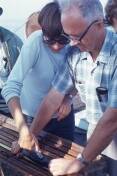
Chile 68 Volunteers with Dr. Allen DeLacy and Dr. John Liston at UW Fisheries Center
fields was very successful, so that current Peace Corps missions nowadays are carefully structured to select volunteers with previous training in the fields in which the host countries request US advice and assistance. What may be an equally valuable measurement of the success of the program was that the Returned Peace Corps Volunteers (RPCVs) also
felt that their Peace Corps service was of considerable assistance to
them personally in several ways. Responding to a survey, nearly two
thirds of the RPCVs stated that they pursued careers in fields back in
the US that were related to the work they did in Chile, and a similar
portion felt that Peace Corps service was influential in causing them to
focus on “helping” professions in their life choices back in the US. And
nearly 80% felt that Peace Corps service was useful in getting them
employment upon their return.
Many of the volunteers in Chile 68 went on to have remarkable careers
that helped shape public policy, education, scientific discovery, and environmental conservation both domestically and abroad. Here are some examples of some of their careers in the fisheries field:
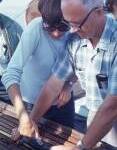
Dr. Allen DeLacy assists Volunteer Liz Garlo
• JB got his PhD at UW and then worked at the Seattle National Marine Fisheries Service for many years, managing several whale population study programs.
• SW got his PhD working with Dr. David Armstrong at UW and then had a long career teaching fisheries science at St. Cloud State University in Minnesota.
• BS worked for many years with Dr. Ernest Salo at UW on many aspects of the polluting effects of oil spills and the Mt St. Helens eruption on salmonid populations.
• HG also worked with Dr. Ernest Salo, on salmonid migration studies. Sadly, he later died in a small plane crash while conducting an aerial river fish survey.
• BL became an Environmental Biologist and managed EPA SuperFund remediation sites over the years, applying science to environmental cleanup.
• JM got his PhD in Evolutionary Biology and spent a lifetime teaching marine ecology, often taking students on hands-on field trips to Central and South America.
• PA conducted research in marine algae farming in Maine and currently advises on marine pollution and green energy.
• JV conducted 12 years of Sea Grant aquaculture research and developed the first commercial production farm for striped bass in intensive geothermal tank systems.
The list of contributions above by the Chile68 Peace Corps group only covers the Fisheries volunteers. There are equally impactful life stories from those trained in Forestry that served in Chile 68:
• EH got his PhD in forestry at UW, became an entomologist working in Alaska, where he has lived for more than 40 years.
• JG got his MS at UW, became a park ranger at Mt. Rainier, and then was hired by the Forestry Dept of Brazil, where he has lived for 45 years, 38 of them as an agriculture professor at the Federal University of Vicosa.
• JC worked as a diplomat with the U.S. State Department for over 35 years.
• JB had a successful career with the National Park Service, rising to become Director of several National Parks, including Big Bend National Park and the Coronado National Memorial.
• RC directed forestry projects in North Carolina and then became one of the first Urban Foresters in California.
• ND got his PhD in agriculture and had a successful career in international agriculture projects in nearly every Latin American country.
• AG became an Environmental Biology specialist and oversaw the environmental impacts of construction projects in the Northeast.
• PG had a career directing water treatment plants in NY. He also went back to Latin America, helping communities to develop affordable water purification systems.
• CH joined the Costa Rica Peace Corps after Chile, where he lived for 18 years, providing diverse engineering services to projects in Latin America.
• SH became an environmental attorney and was the first Director of the Big Sur Foundation. One of his tasks was to work with photographer Ansel Adams to suggest photo opportunities.
• GR was a forester in Maine for 40 years. He also built, funded, and operated six health clinics in Paraguay, serving small and isolated communities where some residents had never had access to a doctor before.
• JR has been a lifelong educator, helping to develop, fund, and administer several Indian tribal schools in Minnesota.
• JY continued her forestry education after Chile, was a BLM forester in Idaho, and then spent 17 years as an IT/GIS Program Manager for BLM.
Throughout their lifetimes, these individuals upheld a shared commitment to environmental stewardship, global citizenship, and community building. Their UW training and Peace Corps experience proved to be catalysts for careers devoted to public service and scientific advancement. Many credit the Chile 68 experience with giving their lives purpose and direction — friendships have endured, and a spirit of camaraderie continues through reunions, field trips, and monthly Zoom gatherings.
The Chile 68 group has had 14 previous reunions over the years. Even though many of the group are now in their 80s, they all travel frequently to attend the reunions and have monthly Zoom get togethers where they sometimes share 57-year-old slides of their time together in Chile. As one Chile 68 volunteer notes:
“The great people I lived and worked with in Chile helped me immeasurably. But what really helped me, and changed my life, was that Peace Corps introduced me to a bunch of people (members of our group) who really seemed to want to make a difference in the world. I had seen that before – for example from my 6 brothers and sisters – but not from such a large group of people. Our lives all seemed like a great adventure that has continued in the 50 years since Chile. I continue to be amazed by all the good energy that comes from our group. Seeing it at the reunions invigorates old dreams. That is all part of why these reunions have become more and more important to me over the years.”
For those youthful, would-be scientists, some of whom began their journey aboard a UW research trawler in 1968, returning to Friday Harbor is not merely a reunion — it’s a reaffirmation of what public service, scientific education, and cross-cultural exchange can build over a lifetime.