Seaplane emergency landing aftermath | Cleanup and investigation
Published 1:30 am Monday, August 3, 2026
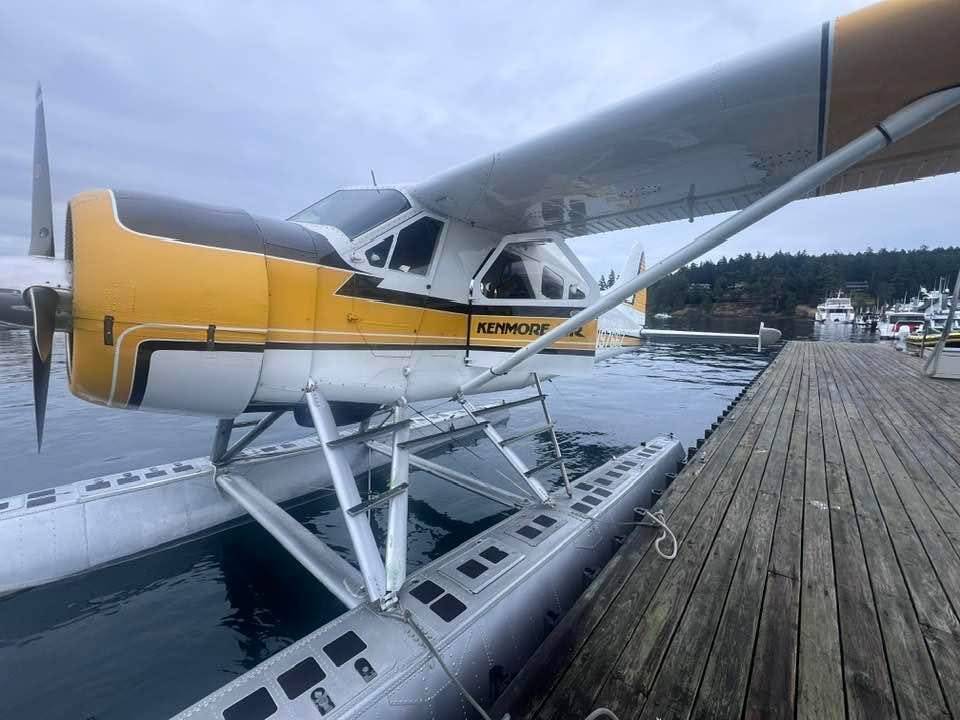
In the midst of a thunder and lightning storm, a Kenmore seaplane heading from Lake Union to Roche Harbor headed north to avoid the storm, then took a 180-degree turn to Shallow Bay on Sucia Island to make an emergency landing on July 23. It was carrying 10 passengers and a pilot. After landing, the floatplane caught fire and came to rest against rocks.
Two childhood friends, Trever Lohman and Carson Scott, were aboard the plane. Lohman told King 5 News on July 31, “We took a tight hairpin turn, and there was a lightning bolt.”
Scott told King 5 he believes he nearly died; his doctor told him he came very close to severing his femoral artery.
“I thought of my family, and my loved ones and just hoped for a quick death,” Lohman said.
The Journal interviewed San Juan Island resident John Nance, a decorated Air Force pilot and a lieutenant colonel in the USAF Reserve. He served as an aviation specialist for ABC starting in 1994, and is a veteran Braniff Airlines captain, and also flew with Alaska Airlines. As an author, he has written “A Splash of Colors: The Self-Destruction of Braniff International” and 22 other books.
“There are three ways of [a pilot] handling thunderstorms: it’s avoid, avoid, avoid,” said Nance, noting that they generally keep a 25-mile radius around such storms. Roche Harbor reportedly had lightning strikes right in the plane’s path.
Witness video footage shows the plane wavering as it touches down on the water. Then smoke appears, and the plane catches fire. Although he himself is not a seaplane pilot, Nance explained that landing planes on the water can be tricky because it’s hard to gauge wave size, especially in storms. If the waves are too high, it can compromise the plane.
According to a U.S. Coast Guard press release, nearby boaters, good Samaritans, and medical professionals in the area conducted rescues, assisted with triaging injured passengers and provided stable platforms for emergency personnel to treat patients before responders arrived. All 11 people on board were rescued and taken to various medical facilities. Passengers Lohman and Scott were treated by the nearby boaters, some of whom were nurses.
“I want to extend my deepest gratitude for the extraordinary interagency cooperation and response during yesterday’s seaplane crash near Sucia Island,” said Cmdr. Beau C. Belanger, commanding officer at Air Station Port Angeles. “Thanks to the rapid coordination between our federal, local, and state agencies, alongside several critical good Samaritans, we successfully rescued and transported patients for medical evaluation and treatment.”
The U.S. Coast Guard Cutter Blue Shark (WPB-87360) and the San Juan County Sheriff’s Marine Unit were on scene during the operation to ensure the safety and security of the scene.
The aircraft was removed from the site on July 24 by salvage contractors hired by Kenmore Air, and officials reported no significant environmental threat. A small, unrecoverable sheen was observed. The plane was carrying approximately 100 gallons of fuel. There is no resulting hazard to marine navigation.
As part of the investigation, National Transportation Safety Board investigators will, according to Nance, interview the pilot to determine his decision-making at each step and analyze the plane itself. A NTSB press release stated they will also be requesting radar data, weather information, maintenance records and the pilot’s medical records, saying “NTSB investigators will look at the human, machine and environment as the outline of the investigation.”
“Every investigation of the NTSB is about facts, not blame,” Nance said, adding that there is a matrix of questions set up to determine the facts and figures of the matter.
A preliminary report containing the information is gathered during the initial phase of the investigation and will be available within 30 days, according to the Safety Board’s press release, and a probable cause of the crash, along with any contributing factors, will be detailed in the final report, which is expected in 12-24 months.
When asked whether this sounded like a typical timeline, Nance said yes, adding that the Safety Board has only 390 employees and is responsible not just for plane incidents but for boats and trains as well.
“They are stretched thin,” he said, adding it is too early to assess cause and assign blame.
Friday Harbor residents have been supportive of the airline and their staff since the accident, bringing flowers and other items to the office on San Juan Island.
“The team has been deeply moved by the support from the Friday Harbor community. People have been stopping by with flowers and other gestures of care, and it has meant a great deal to the Kenmore Air team during an incredibly difficult time. We’re very grateful for that kindness,” said Kenmore representative Aaron Blank.