Hope, love and healing in ‘Talley’s Folly’
Published 1:30 am Wednesday, June 24, 2026
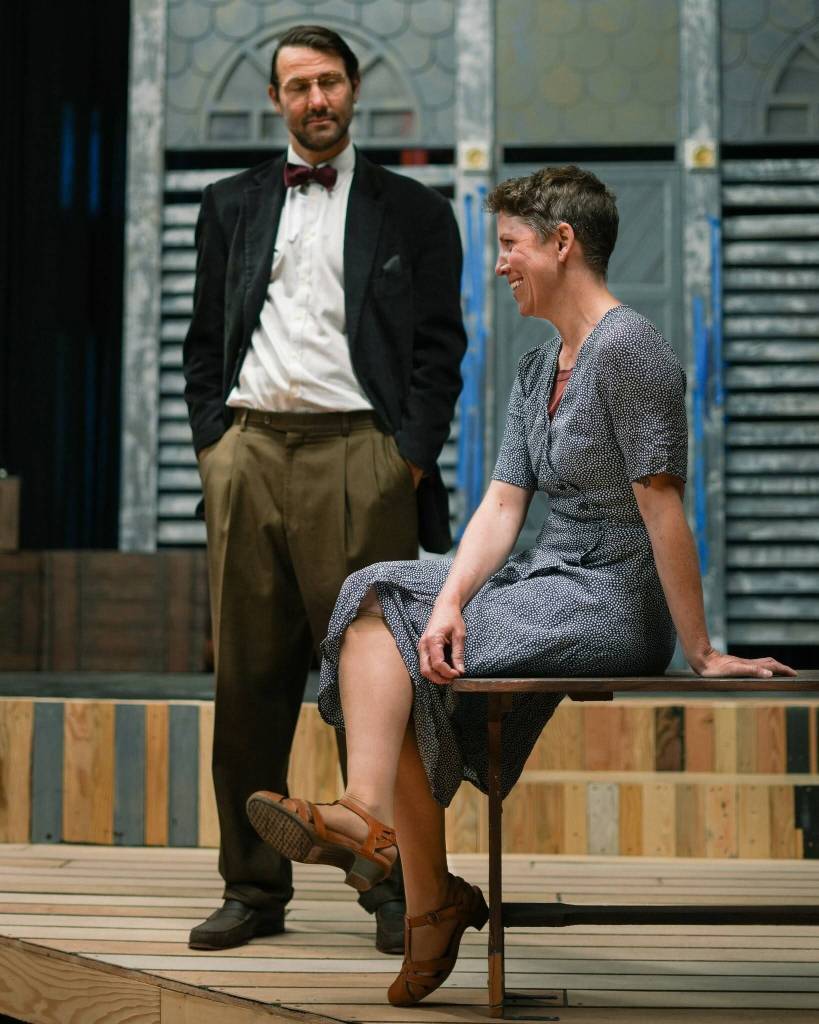



With complex themes of racism, women’s rights, labor relations, wealth inequality and societal and family expectations, “Talley’s Folly” comes to the San Juan Community Theatre July 2 through Aug. 2.
“Talley’s Folly is a hilarious romantic comedy, a Pulitzer-winning play, a bit of a mystery, and a gorgeous way to spend a summer evening. I hope everyone will come out and join us!” said Nathan Kessler-Jeffrey, the theater’s artistic director and director of “Tally’s Folly.”
Written by American playwright Lanford Wilson, the play follows the courtship of Matt Friedman (played by Patriki Holahan), a Jewish accountant, and Sally Talley (Carrie Weaver, with Courtney Kessler-Jeffery as understudy, playing Sally at select performances including Sunday, July 26 and Thursday, July 30), a young woman from a conservative Protestant family. The one-act 90-minute play is known for its candid storytelling as well as the way it navigates themes of love, societal pressure and self-acceptance.
Sally is educated, confident and unafraid, according to Nathan, with opinions that are truly ahead of her time for 1944. She lives in an America where she is expected to support her father, marry young, uphold the status quo and keep the wheel of industry turning without causing a stir.
“She’s far too smart for her surroundings, and is consequently sidelined by her family and romantic partners … The mystery of Sally’s motivations is a huge part of what makes ‘Talley’s Folly’ an intriguing story,” Nathan says.
Matt, meanwhile, has been through his own tragedy. His father and older sister were tortured by the French, causing his sister to fall into a coma. Matt escaped to America with the assistance of relatives. He remains haunted by his childhood grief. Nathan explains:
“[One scene] I love the most has to do with the way individuals try to protect themselves, to stay guarded and safe—not unlike our modern way of keeping others at bay through technology.
Matt has a section that I’m going to paraphrase a bit: “This guy told me people are eggs. Said we had to be careful not to bang up against each other too hard. We had to keep separate, private. He was very protective of his shell…I told him he was being paranoid. What good is an egg? Gotta be hatched or boiled or beat up into something like a lot of other eggs. Then you’re cookin’! I told him he ought not be afraid of gettin’ his yoke broke.”
I find tremendous wisdom in Matt’s words here — they were true in 1944, in 1980 when the show was written, and now. We all have to make decisions about whether or not we are willing to be vulnerable, but without being vulnerable, will we ever be known? And truly loved?”
This being a period piece set in 1944, there was also a lot of research that went into making our costumes, designs and portrayals accurate to the time.
Courtney is also the play’s costume designer and has been the costume shop manager for SJCT since fall of 2021.
“I’ve designed costumes for many of our mainstage shows since then, including ‘Mauritius,’ ‘Shrek the Musical,’ ‘Pirates of Penzance,’ and last summer’s quick change extravaganza ‘The Mystery of Irma Vep.’ I support and oversee our incredible costume, hair, and makeup volunteer teams each show, especially if I am not the primary costumer. I literally couldn’t do this without them,” Courtney told the Journal. Her biggest undertaking has been the overhaul and organization of the costume shop and stock. “We have an incredibly generous community, but precious limited space, so I have to be very strategic about what we keep and what we let go, and making sure it all stays organized and clean. It’s a massive amount of work, but I love organizing – it really kicks my brain into high gear.”
For those who want to support the costume shop, costume donation inquiries can be directed to the Costume Shop Information page on SJCT’s website: https://www.sjctheatre.org/about/costume-donation-info.
The 40s, the time period of “Tally’s Folley,” is one of Courtney’s favorites, due to its practical, utilitarian and minimalist styles with strong silhouettes and luscious natural fabrics — cottons, wools, silks.
“The Hollywood glamour of this era is iconic for a reason — a high sense of luxury came from the movies when so many wanted escapism from the horrors of war, the struggles of food and supply rationing, and the continued recovery from the Great Depression,” Courtney told the Journal. Like most play or musical costume designers, she begins with the script. “I often read through it at least twice to get a sense of the characters and their positions in life — their education, their status in society, their work, their personalities, their family.”
She then takes those observations and begins researching the time period, trying to find things that pop out to her for clues as to what these characters might wear.
Sally, for example, is a 31-year-old woman, born and raised in Missouri, from a wealthy family with whom she does not agree politically, and works full-time as a nurse’s aide in a nearby hospital. Sally is smart, observant, and guarded. Her feelings for Matt have caught her by surprise. In her day-to-day life, she would likely typically be wearing a shirt-waist style dress — a very common garment at the time because of its practicality and limited material needs.
Matt is a 42-year-old Eastern European immigrant who works as an accountant in St. Louis. He is a financial and mathematical genius, but awkward with people, especially women. He covers his insecurities with humor and seeks logical solutions to the problems he faces. From the text, he, by his own admission, does not venture too far out of his comfort zone, even pointing out that he always wears the same tie to work, Courtney says, “How can I reflect the fact that he’s driven out to the countryside to see if Sally feels the same way he does – a massive step out of his comfort zone?”
This is Sidney Herda’s first full set design for us in his role as production assistant, and Nathan says he’s knocking it out of the park! “It’s a beautiful set, in an old boathouse on a river, and Sidney has done a marvelous job of solving the many challenges of the play.”
When asked if Nathan had a particular part that moved him, or was his favorite, he responded, “Sally is on a tear, having just had to deal with her family, who are very upset that Matt is on the property. She comes down, lambasting him for being there, but you can immediately tell that these two have a history and care very deeply for one another. The whole play is a master class in subtext, but that first scene is a real hoot.”
Though the play structure is simple, two actors, one set and no intermission, each show comes with its own challenges. “A fast two-hander is one of my favorite things to direct because every moment must be riveting for the audience. So we’re spending a lot of time making sure that every joke is clear, every bit of conflict is explored, and every bit of flirtatious banter is coming through,” Nathan told the Journal.
Performances run Thursday through Sunday, with a pay-what-you-can preview performance on July 2. Tickets are $27 for adults, $15 for students or $5 student rush. They are available at www.sjctheatre.org.
“’Talley’s Folly’ is a hilarious romantic comedy, a Pulitzer-winning play, a bit of a mystery, and a gorgeous way to spend a summer evening. I hope everyone will come out and join us!” Nathan said.