Renewable energy economics of the San Juan Islands | Column
Published 1:30 am Monday, April 6, 2026
By William Hurley
Hurley is a retired professional engineer in the field of commercial Naval Architecture and Marine Engineering and served as president of a major engineering firm in Seattle. He spent the last 20 years of his 45-year career working in the offshore wind industry, engineering deep-water floating wind turbine foundations and conducting techno-economic studies for the U.S. Department of Energy, large European energy companies and international developers. Hurley is a part-time resident of Decatur Island.
Utility-scale solar energy installations are being proposed for the San Juan Islands in the northwest corner of Washington state. While renewable energy is generally desired among the islanders, of which I am one, it is important to recognize the economics of solar energy.
We face challenges to our energy security. Electricity demand on the San Juan Islands is predicted to grow. The increasing statewide demand for fixed-capacity mainland hydropower could impose a greater percentage of higher Tier 2 electricity prices on us, and there is a concern that our electricity allocations could be limited.
Immediate reaction to these energy security challenges is to add local solar generation capacity, and our energy co-op, OPALCO, is aggressively promoting utility solar energy in the County. Our County’s new 2025-2045 Comprehensive Plan includes extensive utility solar energy installations, yet there has been little discussion of the costs. While seemingly a good idea, the promise of utility solar needs to be tempered with pragmatic realism.
I have prepared an in-depth economic analysis comparing the economics of rooftop solar with utility solar. The study demonstrates that rooftop solar makes good economic sense, but utility solar in the San Juan Islands does not. Here is a link to the full report, https://docs.google.com/document/d/1Nf3u0EBTtMHgki8UJQKseDHr_0XDLxIl/edit.
Rooftop solar
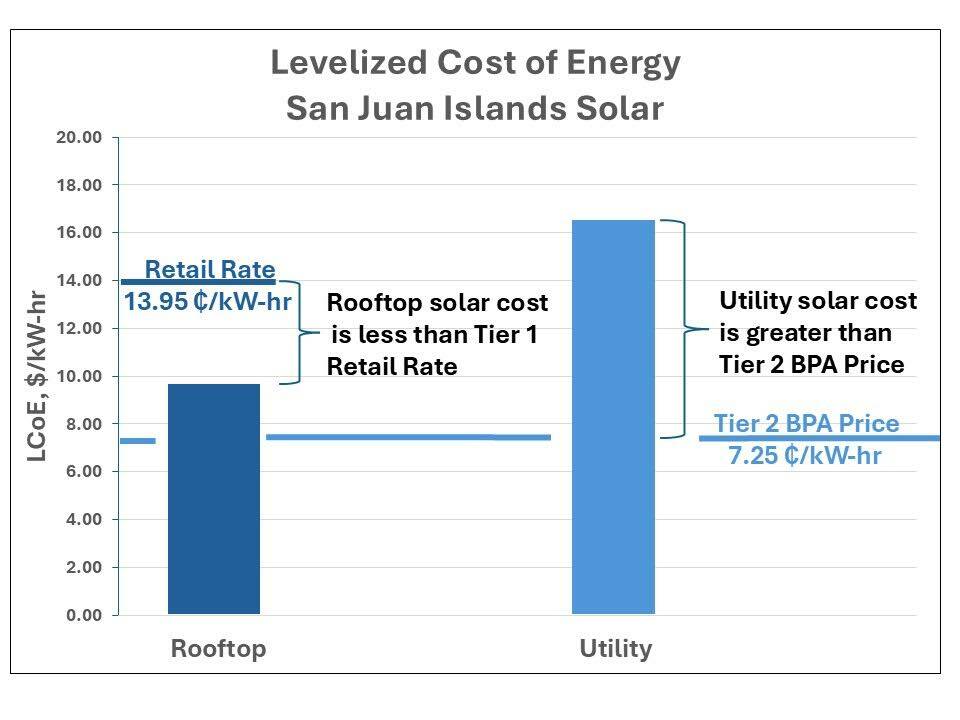
The basic economic measure is Levelized Cost of Energy (LCoE): the lifetime discounted cost in $/kW-hours of a renewable energy installation. LCoE considers all the cost elements and the annual energy production from the specific site. A San Juan Island homeowner who installs a large 20kW rooftop solar installation, utilizing the residential 30% tax credit (good until 2032), and expects a 25-year life from the panels and components, can expect an LCoE of 9.6₵/kW-hr. The homeowner realizes a 3.9₵/kW-hr discount from the Tier 1 retail rate! Unfortunately, the initial installation cost is beyond the financial means of many islanders, and this creates an inequitable situation.
Utility solar
The proposed 8-acre 2,500 kW DC Solar Array Expansion project on Decatur Island consists of two new arrays, and the generated power goes directly into the OPALCO grid with no battery storage.
Capital expenses are high because the installation is on a remote island without ferry access. Costs are estimated to be $4.6M after deducting the $1M WA state grant received to support the project.
Annual Energy Production is low in the San Juan Islands. To make matters worse, the site for the Decatur project is right up against a forest to the south of the arrays, and the forest trees shade an estimated 20% of the array area. The shading reduces the output from the unshaded 13% Capacity Factor to 10%. Capacity Factor, in DC/AC, is the measure of the energy production realized. California, in comparison, has a 23% Capacity Factor.
Combining the high CAPEX with the low energy production, the LCoE of this utility array is 16.5₵/kW-hr, more than twice the current Tier 2 cost OPALCO pays BPA. The high cost of remote island installation, coupled with the very low solar irradiance level, makes solar energy production in the San Juans very expensive.
Conclusion
As San Juan Islanders face our energy future, let’s be realistic in our pursuit of renewable energy. Strategies should include increased energy conservation, growth management and a focus on rooftop behind-the-meter solar.
If we pursue utility-scale solar energy, we need to carefully site the projects. Deforestation and otherwise harming the environment must be avoided in favor of siting panels on impervious surfaces and in dual-use agri-solar locations. The Decatur project, which involves extensive deforestation, needs to be resited.
We also need to take stronger steps to provide equitable access to renewable energy. Significant strategic thinking is still needed before we make a blanket endorsement of utility solar in the San Juan Islands.