OPALCO’s new rates? It’s like Robin Hood in reverse | Guest Column
Published 7:16 pm Monday, April 27, 2015
By Chris Greacen
OPALCO plans to meet its burgeoning operating costs and debt payments through a new tariff structure with unprecedented increases in fixed charges.
By 2019, the base rate will rise to nearly $78 per month before any electricity is used. This is particularly punitive to small users, including the elderly, those on fixed incomes, homes that practice energy conservation, and those with solar panels.
To some, that’s not a lot of money. For others, it means difficult choices between winter heat, putting food on the table, or dipping into life savings.
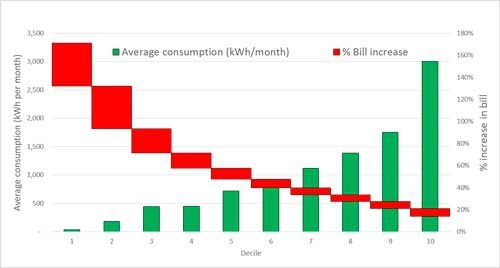
I sorted all OPALCO residential members into 10 equal groups (deciles) based on how much each consumes and found that high facilities charges impact these groups very differently. The 10 percent that consumes the least electricity faces a bill increase of 132 percent to 171 percent by the year 2019, compared to what they would pay for the same amount of electricity in 2014.
The next 10 percent sees an increase of 93 percent to 132 percent. Strikingly, the 10 percent that uses the most will see their bills increase only 14 percent to 21 percent.
Regulatory authorities around the country deny utility requests for high fixed charges with few exceptions.
In March, PacifiCorp (UE 140762) requested a base charge increase to $14 a month, from the current $7.75, and were denied by the Washington Utilities and Transportation Commission (WUTC). The Commission noted, “The Commission is not prepared to move away from the long-accepted principle that basic charges should reflect only “direct customer costs” such as meter reading and billing. Including distribution costs in the basic charge and increasing it 81 percent, as the Company proposes in this case, does not promote, and may be antithetical to, the realization of conservation goals.”
Avista (UE 140188) was granted a modest increase to $8.50 a month from the previous $8. They had requested $15. In California, facilities charges are capped at $10 per month. Southern California Edison charges 99 cents while Pacific Gas & Electric charges less than $5.
OPALCO board member Bob Myhr asked, “what about utilities in other island areas, like Martha’s Vineyard?” Curious, I called up their utility, Eversource. There is no facilities charge.
These charges (even the ones that were denied) are far short of the $78 a month we’re going to be hit with. I don’t think OPALCO’s rate structure would have a prayer of being approved by the WUTC. But that’s a moot point because, as a co-op, OPALCO is not under the WUTC’s jurisdiction. It’s up to us—the owner-members of OPALCO.
Join me in requesting that OPALCO redesign its retail rate structure to make it consistent with long-accepted regulatory principle with facilities charges based only on direct customer costs (metering and billing) and not distribution costs. Needed revenue can be made up through charges based on actual peak demand in a billing period, service amperage, or increases to “regular” energy charges (per kilowatt-hour).
We exercise our regulatory authority when we vote in OPALCO elections. This isn’t much of a lever, considering the nuances and the candidate pool. I encourage votes for Winnie Adams and Randy Cornelius and “yes” on the member-initiated bylaw change.
— Editor’s note: Chris Greacen is consultant to the World Bank on rural electrification. Raised on Lopez, he has a Ph.D., UC Berkeley, in Energy and Resources, and lives on Lopez with his wife and two children.