Nonprofits provide overview on programs and needs
Published 1:30 am Tuesday, January 6, 2026
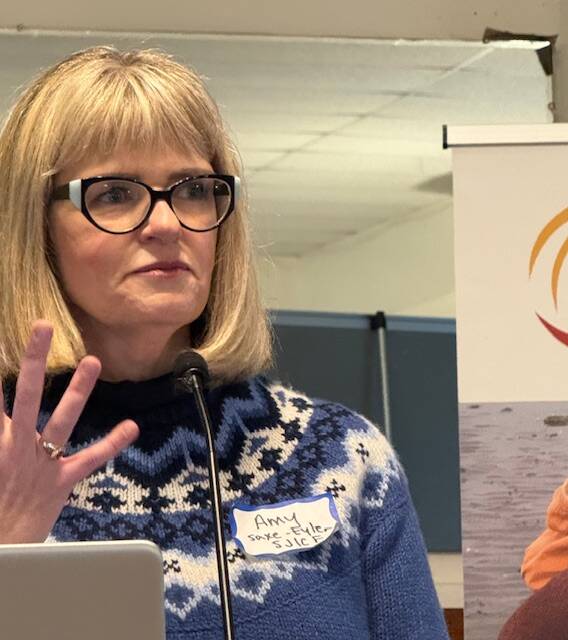
As the nation and states’ support networks thin, local nonprofits gathered together on Nov. 13 to discuss what they do and their unique challenges.
”We’ve been hosting quarterly Lunch and Learn sessions with our nonprofits, but this time feels different, so we wanted to open it up to the community and ask nonprofits to share what they are working on,” Amy Saxe-Eyler, CEO of the San Juan Island Community Foundation, told the crowd. For those unfamiliar with SJICF, it is a 32-year-old nonprofit organization that, among other things, connects nonprofit partners to those who want to support their needs, whether through giving financially, serving on boards or other forms of volunteering.
On hand were presenters from the Joyce L. Sobel Family Resource Center, the San Juan Island Community Home Trust, SAFE San Juans, the Friday Harbor Food Bank, San Juan Mullis Community Senior Center and Compass Health.
Jennifer Armstrong, director of the Family Resource Center, spoke first, providing a brief presentation on a few of the center’s programs.
“The Resource Center offers a very broad array of services, sort of in two big buckets,” she said. The first is concrete social services, things everyone needs to be healthy and safe while living on the island. The other is youth, child and family enrichment programs that help with prevention work and to optimize outcomes, especially for families.
“The two highly utilized services … that we’ve been seeing for the past five years … is rental assistance and housing stability services, along with behavioral health support,” Armstrong explained. “Behavioral health support extends across a broad demographic, ranging from prenatal mental health services for expecting families, all the way up to income-based counseling for seniors.”
With health insurance issues looming, Armstrong delved into what the center is seeing in terms of impacts or potential impacts of rising health insurance costs.
“Rate increases are going to be a major driver for household instability for families needing other types of services. Right now, about 21% of our county residents rely on Medicaid or Apple Health. The good news is that about 87% of our county residents are currently insured,” Armstrong told the crowd, “that is a little less, actually, than the state average.”
The average insurance rate increase this year, she continued, is 21%, due to the expiration of the ACA tax credits. Should they not be renewed again this year, in 2027, costs will rise again.
“What does that actually look like for families here, for a family of four living on $45,000 a year? I’m not sure if anyone is in touch with many families who are pulling that off in our community, but we do definitely have families that are living on that kind of income. Up until now, those families have been able to get free health insurance. This coming year, they’re going to need to come up with about $1,600 to maintain their insurance. To many of us this seems like a small number, but if you’re living paycheck to paycheck, finding an extra $1,600 a year is no small feat.”
Armstrong added that the median household income for a family of four in the county is about $111,000. With the insurance increases, they will be paying approximately 10% of their income to health insurance. The result is that even middle-income families who have been able to set a little bit aside for a safety net will be using those funds on health insurance.
“We really worry that we will see big upticks in the needs for all sorts of services, ranging from rental assistants to nutrition support, utility support, when things get stretched really thin. As we’re looking ahead, how do we handle this? We just navigated a short-term food crisis, and I can say with confidence we’re a perfect example of a community that’s not going to let our neighbors starve. But none of us are going to have the capacity to cover our neighbors’ medical bills. There’s no one great answer to this problem, but what we’re doing is we’re really starting to shore up now services that focus on preventative care and expansion of free resources.”
Those include working to build community health worker capacity to help clients navigate the increasingly difficult systems of care, organizing pop-up clinics for islanders with no insurance and pop-up clinics for low blood sugar, blood pressure and eye exams, working with partners ranging from the County health department to Peace Health and off-island providers as well.
The Resource Center is also working with the Washington State Department of Health to bring its caravan to the island.
Armstrong closed with “That’s our focus this year, really continuing to create space to bring community together across a wide age range, a wide demographic that includes bringing partner organizations together. I’m confident that in the next year, a big part of what we’ll all be talking about is new and expanded partnerships across our agencies.”
Rachelle Radonski, director of the Friday Harbor Food Bank, was next. She talked about the amazing outpouring of support from the community, not just in food donations, but new volunteers stepping up as well.
“We have definitely seen our numbers rising,” Radonski told the crowd. “We feel a little bit of stress, and when our clients are in our store, you can definitely sense it. People are worried about what’s going to happen next.”
The Food Bank, Radonski assured, is ready. “We are ready to take people on and feed them and make sure they’re staying healthy and happy as well as we can.”
Going to the food bank is not always easy, standing in line across the street from Market Place and showing vulnerability.
“So what we’re trying to get out in the community is [that] it’s okay. It’s okay to be vulnerable. We are here and we have wonderful food to share. Honestly, a lot of the folks you see in line are volunteers. They are getting food for somebody else. So just because someone is standing out front doesn’t mean they are needing food or needing help.”
While the Food Bank has been receiving wonderful donations, Radonski also reminded attendees, “This is something that’s not going to go away; your continued support is definitely needed.”
Approximately 3,000 individuals passed through the Food Bank’s door in 2024, according to Radonski, and the number rose in 2025. “This is normally when our numbers go down because of our summer industry … but those numbers are not going down this year,” she said.
The Mullis Senior Community Center director, Anna Coffelt, spoke next. Whatcom Council of Aging contracts the center’s Meals on Wheels program, so she brought Christopher Orr to discuss the nutritional program.
Orr explained that there are two aspects to the program. The senior community meals held at the Mullis Center two days a week, Mondays and Wednesdays, are projected to serve 7,000 seniors this year.
The home-delivered program served 17,000 meals in 2025. The program had been growing, Orr explained, but during COVID, it skyrocketed, and the numbers have not come down.
“There are two aspects to that program. There is food security, making sure people have a good, hot meal. A lot of people rely on this as a primary meal. Food and nutrition is so important to everybody’s health, but equally important to health is connection and battling isolation.”
With that in mind, drivers are keeping an eye on what is going on with that senior and can report any concerns. They are often the first line of defence in advocating for the senior.
Orr shared comments from some clients. “You’re all like guardian angels, and always make me smile,” one said. “It’s the only food I get that I can count on. I’ve had so many fun and meaningful conversations and good laughs with the Meals on Wheels drivers. So grateful.”
And “Meals on Wheels just saved me by food delivered when my glucose had dropped severely. I am so appreciative of the service. I can not thank you enough.”
Orr closed with encouraging everyone to check on their neighbors, knowing who is on their block and who is on their street that could use a meal or a visit.
Evan Perrollaz, president of the San Juan Islands Healthcare Foundation, spoke about the need for the recently created nonprofit.
Working with the island’s most vulnerable population, Perrollaz said, he saw the need firsthand.
“Oftentimes, I would do a meet and greet at a client’s or potential client’s home, and I would see the conditions they were living in. I would open up the refrigerator and we what they were eating or not eating,” he said. The foundation was created to fill some gaps and attend to some of those needs, assisting with personal care services, making sure their hygiene is taken care of, and that they are not left isolated.
“We are not a permanent solution, but we will get people back to baseline,” Perrollaz said.
Valerie Mitchell, program manager for Compass Health outpatient programs, gave a presentation about Compass Health.
Compass Health serves a number of Northwest counties, including Snohomish Island and San Juan. Compass has a number of outpatient mental health programs, including child and family, and school-based programs, and outpatient substance use disorder treatment. Compass has a team of mobile crisis outreach responders. This group works with clients in crisis who voluntarily want to receive crisis services. They have a direct link to local designated responders for any client or resident who may need involuntary hospitalization services. The Recovery Navigator Program is a long-term recovery case management program that offers peer support and case management to reduce barriers to accessing services. Neither the Navigator or Crisis services require health insurance, so anyone may utilize those services.
“Our Mobile Crisis team and our Recovery Navigator Program are in the community and on the ground working directly with all of these organizations and making sure clients get connected to the care they need,” Mitchell said. “And the Mobile Crisis team is not just to intervene in crisis but to help prevent a client from going into crisis. If you are worried about someone, you can call and get a consultation; you can call anonymously.”
Dave Dunaway, director of SAFE San Juans, told the crowd the nonprofit provides services for an average of 130 family units every year. There is no charge.
“We are foremost a crisis agency. The people who come to us are in crisis. The crises that we respond to are domestic violence and sexual assault. We have a 24/7 crisis line that people can call.”
The people SAFE San Juans sees are people who are fearful for themselves, for those in their care and for those they love.
Safety planning is one of the key steps staff work with their clients on, as well as legal, medical and financial advocacy. They also provide emergency shelter if and when needed.
“We also do a lot of mental health counseling. Imagine the effect of a person’s whole sense of self when they have experienced the things we have been talking about.” They also do counseling for survivors of child abuse. “This is something new to us, and is the result of a generous gift.”
Prevention work and education are constant and critical. SAFE averaged 200 lessons a year, Dunaway said.
Challenges include upcoming transitions, including board and potential staffing changes.
“If serving on the board, working in the world where domestic abuse and sexual assault, sounds appealing,” Dunaway said, “We don’t request a lot of fundraising. But if you have the perspective and wisdom, you could be a fit.”
Amanda Lynn, director of the San Juan Community Home Trust, addressed the need for affordable housing.
“It’s hard not to see the housing crisis as an existential crisis,” she began. “The fundraising for our current project is something like $27 million to build 40 units of housing. That feels insurmountable in some ways.”
But it’s not, Lynn assured, “We have a lot of passion, resources and power in this community to address our housing needs.”
The middle class on the island is disappearing, partially due to a lack of housing. The Home Trust, Lynn said, is currently working alongside the county and the state on a program that serves low-income and moderate-income folks in the Argyle development.
“One of the reasons I’m so passionate about community land trusts is because of the way they can undo past wrongs, create equitable opportunities for home ownership for people who have historically been left out of the equation,” Lynn told the crowd, adding that 74% of the trust homes are owned by women who are head of household, compared with only 10% in Friday Harbor. Another 27% are owned by black, indigenous or people of color. Homeownership in Friday Harbor amongst that demographic is only 12%. Lynn added later that with land trusts, the imagination is the limit.
“There is so much we can do, we have so much power here, the first step is getting engaged, ” Lynn closed.