Voters reject levy lid lift: County faces hard choices ahead
Published 1:30 am Monday, May 4, 2026
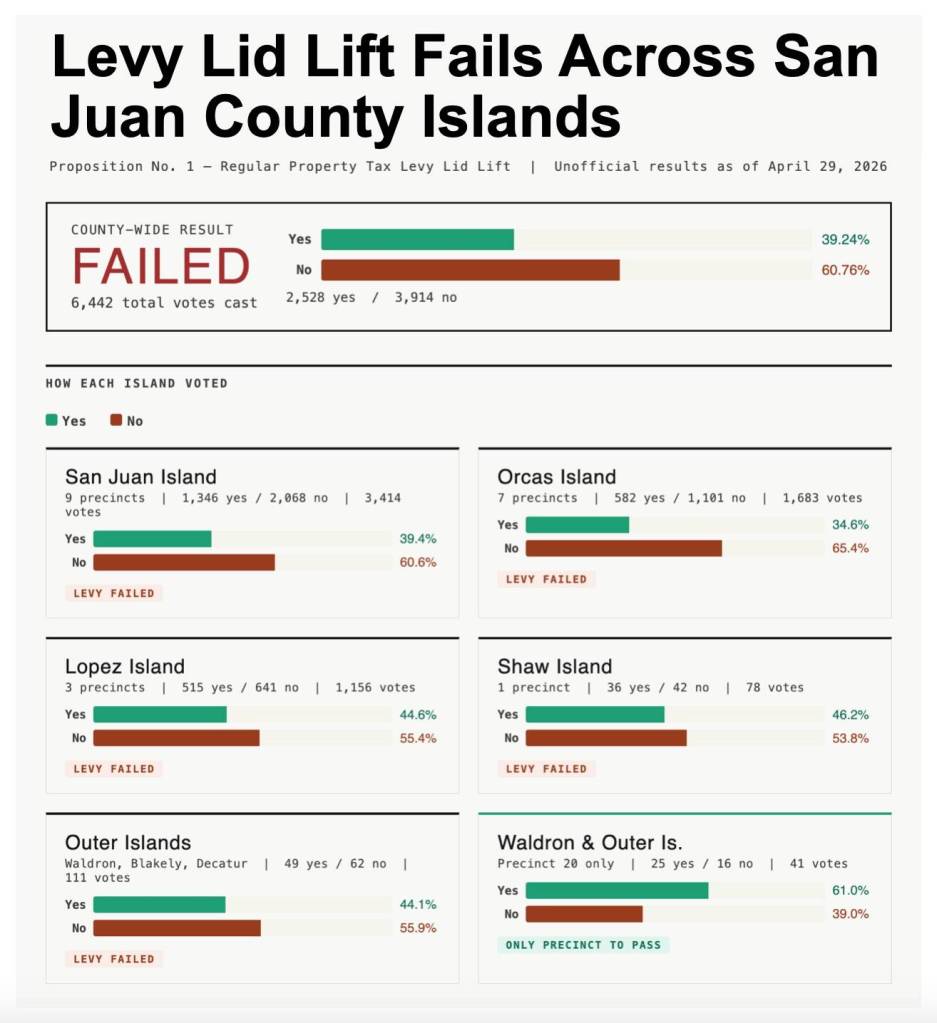
San Juan County voters delivered a decisive verdict on April 28, rejecting the County’s property tax levy lid lift by nearly 61% to 39% — 3,914 votes against, 2,528 in favor. The measure failed on every island except the Waldron & Outer Islands precinct, which backed the levy 61% to 39% on just 41 ballots cast. Orcas led the broader opposition at 65.4% no, followed by San Juan Island at 60.6%, the Outer Islands at 55.9%, Lopez at 55.4% and Shaw at 53.8%. All results remain unofficial.
The failed measure would have reset the County’s general property tax rate to $0.85 per $1,000 of assessed value — the same rate voters approved in 2019 — generating roughly $4.5 million annually. For the median homeowner, it amounted to about $22 more per month. Without it, the County now faces an estimated $3.7 million budget gap for 2027, and the cuts will be real.
“It is incredibly sad and it won’t be very long before the community sees the devastating losses,” said Council member Kari McVeigh. Parks, the county fair, 4-H, Meals on Wheels and early childhood services are all on the table — none mandated by the state. If eliminating those programs still isn’t enough, reductions to law enforcement and the courts may follow. “County council is mandated by law to balance the budget,” McVeigh said. The Council begins that process May 11. McVeigh also offered her read on what might have driven the no vote: “I think we have a war in Iran that’s raising inflationary prices even further than that. Grocery prices are up. Personal insurance prices are up. Gas is over $6 a gallon. There’s fear that none of this is gonna get better in the short term, that we’re headed for far worse for personal property. And I think there were people who just said, ‘I can’t do one more thing, this is too much.’”
Council Chair Justin Paulsen was equally direct about his framework going forward: Health, safety and state-mandated services come first. Everything else will be evaluated. He said the County will look at all programs and departments, “and we will be trimming back to only those things that are essential.” He added that all decisions will be made in public session, and urged residents to attend and speak up. “If it’s a want, it’s likely not savable.” Paulsen also pointed directly to what drove the spike in property taxes: “Our fire district, our school district, our hospital district, and our library district all passed levy lid lifts in the same year’s taxing period. So we saw incredible increases in all of those districts in a one year period, which is why everybody saw a noticeable increase in their property taxes this year.”
County Manager Jessica Hudson noted that the County had already absorbed $1.7 million in ongoing cuts for 2026 — three staff positions eliminated, parks and health department budgets slashed, the main stage at the fair gone. “At this point, there is no low hanging fruit,” she said. “All of the reductions the county is going to have to contemplate for next year have impacts on public services.” Hudson was direct about what the vote means: “People showed through their votes that they were not interested in paying additional property taxes for the services that the county offers. And that means we will have to make reductions. But where we take those reductions should be influenced by the people who utilize them.” She urged residents to stay engaged: “Just keep an eye on the council agendas. And when you see a budget item, listen in. We don’t want them to be a surprise to people, but they will happen.”
About property taxes
One persistent misconception in the community is that rising assessed values directly cause higher tax bills — and that the Assessor’s Office inflates values to collect more money. San Juan County Assessor John Kulseth pushed back firmly. “We’re not raising the assessed value on anything we do here,” he said. “It’s what the market is doing outside of the room that is telling us to set assessments.” Washington state requires assessors to value property at market value using actual sales data. The office has no financial incentive to appraise high.
“The thing that controls the amount of taxes is the taxing district’s budget,” Kulseth said — not the assessed value. He also noted something that surprises many residents: In a declining market, property taxes can still go up. “Your assessed value going up is a good thing in the sense that we could be in a depressed area and your value could be going down. If the value goes down, your taxes will probably still go up because the taxing districts are all going to want more money.”
For retired residents on fixed incomes, Kulseth also wants people to know relief may be available. Washington state’s senior exemption program offers three income tiers — $54,000, $63,000 and $72,000 — and every qualifying homeowner receives a lower levy rate with their assessed value frozen at entry. Higher tiers receive an additional discount on top. In San Juan County, roughly 450 people currently qualify, with an estimated 150 more eligible under recently updated income levels. Anyone who thinks they may qualify should call the Assessor’s Office.
Homeowners who believe their property has been incorrectly assessed should start by calling the Assessor’s Office, where staff will review records and photos and work through the details together — and many disputes are resolved at that level. If the issue isn’t settled there, residents can file a free petition with the Board of Equalization, an independent three-member panel completely separate from the Assessor’s Office, where, as Kulseth puts it, “We tell our story and the homeowner tells their story and the board makes their ruling.” Kulseth said his office aims to be fair above all else. According to the San Juan County Board of Equalization website, the filing deadline is July 1 of the assessment year or within 30 days of receiving a Change of Value Notice — whichever is later. There is no fee to file, and petitions can be submitted online, by email to boe@sanjuancountywa.gov or by mail to 350 Court St. #2, Friday Harbor. The county website notes that strong evidence includes comparable market sales or a recent independent appraisal; the amount of tax owed, personal hardship and percentage of increase are not considered valid grounds. Homeowners still unsatisfied after the board’s ruling can appeal further to the Washington State Board of Tax Appeals within 30 days of the county board’s decision.
The case against
Not everyone was persuaded. In letters to the editor published in the Journal and Islands’ Sounder before the vote, several residents offered pointed critiques that may have resonated with some of the 60% majority.
David Jenkins urged voters to consider affordability for renters, not just property owners. “Property owners cannot simply absorb lid lift after lid lift,” he wrote. “The cost to the property owner is simply passed along to renters in the form of higher rent.”
Lauren Cohen questioned the ethics of the County mailing levy promotional materials at taxpayer expense. “Using public monies meant for services for a marketing campaign promoting their own tax increase is alarmingly unethical,” she wrote, adding that County officials had been spending freely for years and were now treating property owners “like personal ATMs.”
Stephanie Johnson O’Day called for internal discipline first. “Several county departments are already top-heavy,” she wrote. “Instead of asking residents to pay more, the council should sharpen their pencils.”
The frustration is understandable, Paulsen said — but the structural problem driving it won’t go away on its own. Washington’s 1% annual cap on levy increases guarantees that districts will periodically need to reset their base rate. On Orcas, four taxing districts — fire, school, hospital,and library — all did so in the same cycle, hitting residents simultaneously. “When that happens,” Paulsen said, “it’s huge.”
The state’s role
Council member Jane Fuller, who is finishing her final term, pointed to a deeper structural problem beyond the levy vote itself — one playing out in all 39 counties across Washington state. “San Juan County is one of the rest of the counties in the state that are being severely financially constrained year on year because of the levy lid at 1%,” she said. Fuller argued that the state has repeatedly sidestepped the hard work of restructuring its own finances, instead granting counties permission to raise local taxes through “councilmanic” actions — bypassing voters entirely. She said she has grown frustrated watching the pattern repeat: “I am tired of the state giving us permission to ‘countymanically’ pass legislation to increase taxes on our local people,” adding that legislators lack the will “to do the difficult work of reorganizing their financial house.” She noted that Gov. Bob Ferguson effectively killed any chance of relief this session by declaring early on that raising the 1% lid to 3% was off the table, even as state legislators signaled interest. Adding to the pressure, Fuller warned that San Juan County is facing a cut of as much as $250,000 in foundational public health services funding from the state — with some staff already notified of potential layoffs — starting in July. “The state is not doing us any favors,” she said.