Mosquito Fleet bill passes House 84–11, faces uncertain fate in Senate
Published 1:30 am Wednesday, March 11, 2026
By Darrell Kirk
Staff reporter
The Mosquito Fleet: A brief history
Long before the era of the automobile ferry, Puget Sound was alive with a bustling network of small passenger steamers known as the Mosquito Fleet. According to Joe Williamson and Jim Gibbs in “Maritime Memories of Puget Sound in Photographs and Text” (Superior Publishing Company, 1976), these colorful little vessels called at countless docks throughout the Sound — from Port Ludlow and Port Madison on Bainbridge Island to Alki Point, Tacoma, and dozens of smaller whistlestops in between. At the heart of it all was Colman Dock in Seattle, where steamers like the Indianapolis and the City of Everett lined up side by side, operated by competing lines including the Kitsap County Transportation Company, the West Pass Transportation Company and the Black Ball Line, which ultimately bought out most of its rivals.
The fleets’ decline came with the rise of the automobile age. As demand for car-carrying capacity grew, the smaller passenger steamers passed into oblivion, and many smaller ports faded quietly into village life. The grand era ended with a celebrated 1948 race between the Virginia V and the Sightseer on Elliott Bay — the last chapter of a maritime world that had defined Puget Sound for generations.
A bill born from crisis
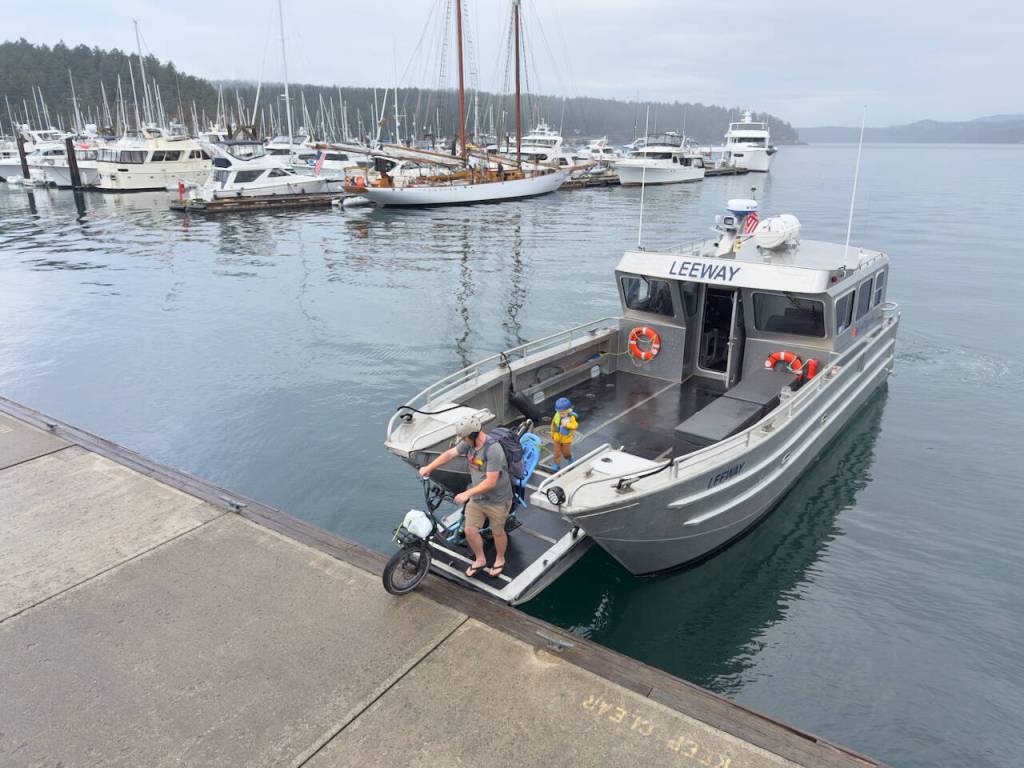
Now, nearly eight decades later, a new chapter may be at hand. On Feb. 27, the Washington State Senate heard testimony on House Bill 1923, the Mosquito Fleet Act, which would empower counties, port districts, transit agencies and other local jurisdictions to establish passenger-only ferry service districts across Puget Sound and Grays Harbor. The bill passed the House by a strong bipartisan vote of 84 to 11 and awaits action in the Senate.
It arrives at a moment of acute crisis. Washington State Ferries is grappling with a $231 million vessel preservation backlog — projected to reach $390 million by 2040, according to WSF figures cited in committee testimony by Walt Elliott, Kingston Port commissioner — and sailing cancellations have become routine. HB 1923 would not replace WSF but create a complementary framework for locally funded, operated passenger-only service — financed through sales taxes, commercial parking taxes, passenger tolls and leasing fees.
“When the boats don’t run, everything stops”
No testimony put the stakes in sharper relief than that of Evan Perrollaz, mayor of Friday Harbor. Just that week, ferry cancellations had left travelers waiting more than 10 hours to reach their destinations. “For us, this isn’t an inconvenience,” he told senators. “It’s a disruption to medical care, access to government services, commerce, education, and family life.”
Unlike mainland communities, Friday Harbor has no alternate route. No highway, no bridge, no workaround. “When the boats don’t run, everything else stops for us.” Perrollaz spoke, too, from personal experience. “Like many island families, I have elderly loved ones who require regular off-island medical care. When ferry service becomes unreliable, we’re forced to worry whether critical appointments will be missed. No community should have to live with that uncertainty as a routine part of their life.”
Justin Paulsen, San Juan County Council chair, told the committee that the strain on the state’s marine highway has only deepened. “This impact is not limited to our standard highway system, but it strengthens into the state’s marine highway system, which is an integral part of the connection between communities based on the Salish Sea.” The costs and timeline to fix WSF, he noted, “will be measured in terms of hundreds of millions of dollars and span multiple decades.”
HB 1923, he argued, offers something WSF cannot right now: speed and local ingenuity.
Jane Fuller, San Juan County Council member and chair of the newly formed County Ferry Caucus representing 12 counties, brought the point home with stark timing. Three hours before her testimony, she had received a WSF email alert: six sailings the following day would be canceled, with a 20-vehicle capacity reduction on the main vessel for several weeks.
“Those kinds of disturbances are a regular occurrence on our route, causing major social and economic disturbance to the people of San Juan County,” she told senators. Her ask was unambiguous: move the bill to the Senate floor.
Kitsap Transit: Proof it works
Across the Sound, Kitsap County has already shown what passenger-only ferry service can become. Kitsap Transit has operated routes since voters approved a countywide ballot measure in 2016, building a fleet of 10 vessels, five routes and an annual operating budget of $28 million sustained through sales tax and farebox recovery.
The effect on Kingston — a ferry-dependent town of 3,000 — has been profound. Former Port Commissioner Walt Elliott told senators the service “kept us from becoming a community of retirees” by allowing workers to keep Seattle jobs and access affordable housing, rather than endure a 90-minute drive on a congested Interstate 5.
Marcia Cutting, a Bainbridge Island resident who uses a wheelchair, described navigating from Bainbridge to Port Orchard by state ferry, fast ferry and foot ferry when her accessible van was unavailable. The trip was faster than the bus — and, she noted, it was a gorgeous summer day, with a 180-degree view from the stern. “I think it’s time that we consider getting off the roads and onto the water,” she told the committee.
Washington-built vessels and green jobs
Beyond immediate transportation relief, HB 1923 carries significant promise for Washington’s maritime workforce. Paulsen noted the bill offers “a chance for our local experts in the maritime industry to grow their businesses and help expand the local marine economy.”
Dylan Doty, testifying on behalf of Kitsap Transit, told the committee that the agency has already put Washington shipyards to work: “We have built several here in Washington through both Nichols Brothers and All-American Marine up in Bellingham.”
Seamus Nolan, director of Commercial and Government Affairs at Switch Maritime — a company that stands to benefit commercially from expanded passenger ferry demand — testified that his company has gone further still — developing and operating “the first zero-emission hydrogen fuel cell electric ferry in the United States, the SeaChange, which we built up at All-American Marine up in Bellingham.” Switch is now advancing a 150-passenger hydrogen ferry capable of full-day, high-speed service with a single daily fueling, targeted for passenger service as early as mid-2028.
“The Mosquito Fleet Act would offer jurisdictions throughout the state the ability to deploy modern and dependable ferries,” Nolan told senators, “while lowering emissions in a cost-effective manner on an accelerated timeline.”
We can’t afford to get this wrong
Not everyone who testified was without reservation. Donna Sandstrom, founder of The Whale Trail and a former member of Gov. Inslee’s Orca Recovery Task Force, offered a measured but urgent warning. The Southern Resident orca population has reached 76 individuals — including 13 calves — a hard-won recovery. But those whales swim in the same waters where new fast ferry routes would operate.
“Unmanaged and unmitigated growth of this sector has the potential not only to be catastrophic for the Southern residents, but to undo every bit of progress we have made in the last seven years,” Sandstrom told the committee. She did not ask senators to kill the bill — only to get it right. “It doesn’t have to be a choice between human needs and orca protection, but we need to be smart about how we do it.” She called for mandatory permitting, best-practice requirements as a condition of operation and fees to support the Department of Fish and Wildlife enforcement.
“We can’t afford to get this wrong and fix it later,” Sandstrom urged the legislators.