Lawmakers move to regulate license plate cameras
Published 1:30 am Sunday, January 25, 2026
By Cassie Diamond
WA State Journal
Washington state lawmakers want to rein in how license plate cameras, designed to track vehicles, can be used.
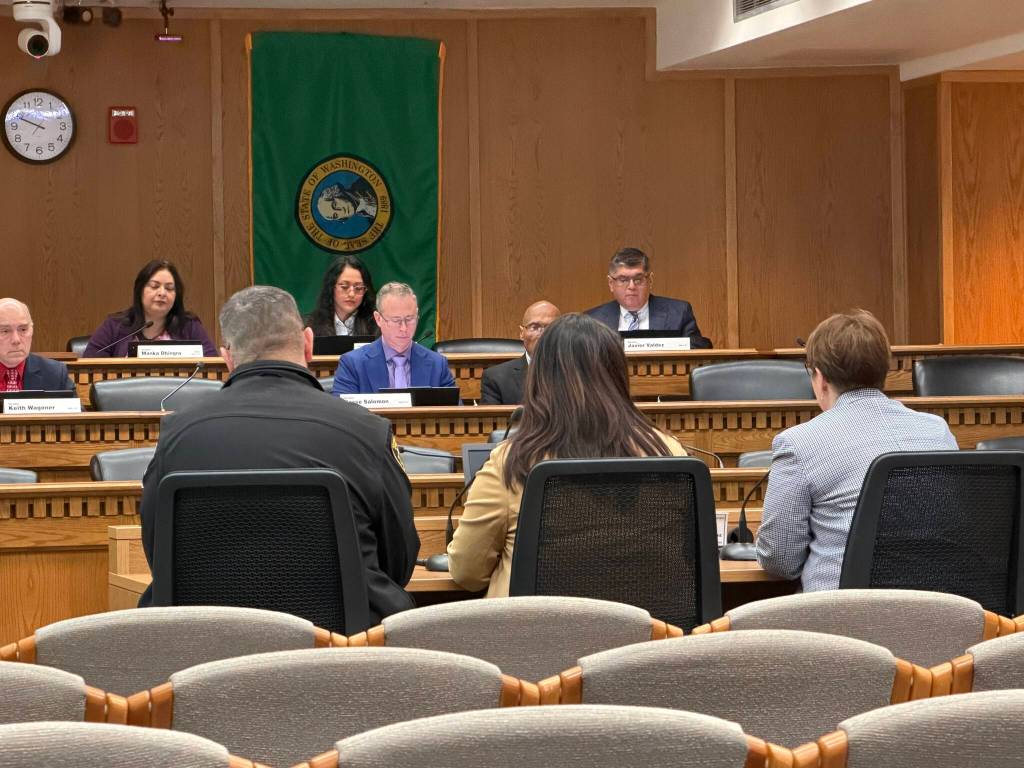
During a public hearing on Jan. 20, Sen. Yasmin Trudeau, D-Tacoma, cited a recent University of Washington report that revealed federal immigration authorities were accessing data obtained by automated license plate reader systems in Washington as a major reason why the state must regulate these cameras.
Trudeau is the sponsor of Senate Bill 6002, which would create a regulatory structure for ALPR systems and the data captured by them. Washington has no laws regulating ALPR systems.
“Allowing surveillance technologies without any oversight or regulation, I believe, is an affront to our state constitution,” Trudeau said, “and I brought this bill because I think it’s our job to figure out how to get this issue right.”
Under the proposed bill, ALPR systems could be used lawfully by law enforcement to compare collected data against certain watch lists, by parking enforcement agencies to enforce time restrictions and by transportation agencies for public studies.
The measure would explicitly prohibit the use of ALPR systems for immigration investigation or enforcement, tracking protected activities such as free speech and collecting data near protected health care or immigration facilities.
It would also forbid an agency from disclosing, sharing or permitting access to ALPR data except in judicial proceedings.
A companion bill in the House, House Bill 2332, seeks to implement the same regulations.
The sponsor of that bill, Rep. Osman Salahuddin, D-Redmond, emphasized that while ALPR systems do have legitimate uses, the risks also need to be taken into consideration.
“We want law enforcement to have the tools they need to solve crimes,” he said. “But at the same time, we need to respect community surveillance concerns and ensure that this use of data aligns with our values as a state.”
However, law enforcement officials have concerns about the bill. In particular, they take issue with the fact that the measure would require all ALPR data be deleted within 72 hours, with specific exceptions.
“The 72 hour retention period is insufficient,” Darrel Lowe, the police chief of Redmond, said. “Investigations don’t work on a three-day timeline. Three days or three hours provides no investigative value and masquerades as privacy.”
Trudeau acknowledged the unpopularity of the current retention period and said there will be many opportunities to discuss that aspect of the bill.
Andy Caldwell, the police chief of Centralia, said there is a need for legislative oversight to govern the use of ALPR systems by law enforcement. However, he argued that there is considerable misinformation circulating about how ALPR systems function and are used.
“This is not surveillance,” he said. “We don’t know where you’re going, we don’t know who’s in the car, we have no idea where you’re coming from. It’s just a data point that we use for investigations.”
SB 6002 has some bipartisan support, with Sen. Jeff Holy, R-Spokane, the top Republican on the Senate Law and Justice Committee and a former Spokane police officer, co-sponsoring the bill.
“Are we seriously going to argue that people don’t have a reasonable expectation of privacy when it comes to every single movement being tracked?” Holy said.
SB 6002 is scheduled for an executive session on Jan. 22 in the Senate Law and Justice Committee.
“I brought this bill because I believe every Washingtonian deserves to know when their data is accessed by their government,” Trudeau said, ”and that they understand why and how that information will be protected when it is used.”
The Washington State Journal is a nonprofit news website operated by the WNPA Foundation. To learn more, go to wastatejournal.org.