‘Parrot Kindergarten’ spotlights a quiet revolution
Published 1:30 am Tuesday, August 26, 2025
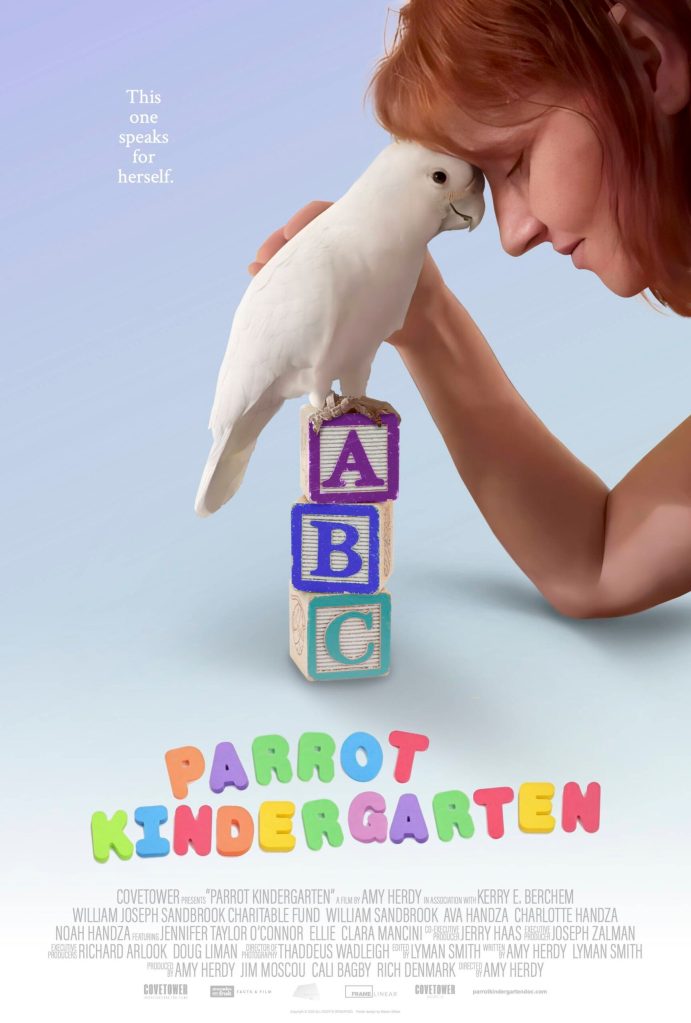
Breaking science shows animals may communicate and have more sentience than humans realize. “Parrot Kindergarten” follows the journey of a woman, Jennifer Taylor O’Connor, and a Goffin’s cockatoo named Ellie as they heal from past traumas, bond and learn together. The documentary was directed by islander Amy Herdy and put into production under the company she co-founded, Covetower.
“What if animals know more than we know? What if they are capable of communication, of feeling, of love and loss?” O’Connor asks in the opening of the film. Both a teacher and a lawyer, O’Connor worked with Ellie on communication, starting with letters and words on cards. She then developed a system where Ellie can select images on a tablet using her beak and tongue. Topics on the tablet range from treats, activities, to those surrounding emotions, including grief. The result is a scientifically peer-reviewed paper, “Communication Functions in Speech Board Use by a Goffin’s Cockatoo: Implications for Research and Design.”
One of the funniest moments in the documentary shows O’Connor attempting to establish intent by not giving Ellie the treat she asked for. In one instance, Ellie had selected sunflower seeds from her tablet treat menu.
O’Connor brought her a piece of broccoli instead. Ellie not only refused the broccoli, she brought sunflower seeds back up on her tablet, and “looked at me like ‘are you ok?’” O’Connor laughs in the film.
The film concept came about, she told the Journal, after being contacted by one of the film’s producers on Instagram.
“It was a DM and I thought maybe they were someone trying to trick us into selling a kidney—you never know what’s out there on the internet! After a few more exchanges, I agreed to meet with Amy (just in case it wasn’t a kidney scam!),” O’Connor said. “Ahead of our meeting, I’d sent her my story manuscripts, probably about 600 pages across three books. When we met a few days later, she’d read all of my manuscripts, knew each part of our lives already in such detail. I felt instantly that she was someone who truly cared—about victims, about agency and voice for women—and about the sentience of animals, too, who are often so vulnerable.”
True to form, O’Connor continued, the entire filmmaking process was this way — it was created with kindness, intention, care and agency. “There were three film shoots, and each one was really crazy fun! The filmmakers got to know the parrots ahead of the filming, so they weren’t nervous. In fact, the parrots probably had their favorite weeks ever—there were dance parties and cuddles and treats!” O’Connor said.
Herdy told the Journal, “Jen’s work with Ellie is like witnessing a quiet revolution.”
While she got some pushback, which typically happens at the beginning of a project, her Covetower teammate, investigative journalist Cali Bagby, got it right away.
“The thing that really touched me the most about the film was that if people are having these close relationships with animals, and they’re communicating with them and the animals are expressing their pain, then it’s much harder to have the argument that torturing animals is okay,” Bagby told the Journal. Multibillion-dollar or trillion-dollar companies profiting off torturing animals have been around since the agricultural revolution. “It’s so deeply ingrained in our culture. So, for this idea that animals have a voice, butts up against that idea, and that’s a really groundbreaking,” Bagby explained, adding some people are bound to believe the notion of animal communication or sentience is crazy.
“Parrot Kindergarten” shows, Bagby says, not just the potential for animal communication and sentience, but the truth of it. “It’s the truth that animals are expressing themselves and experiencing pain just like humans do.”
They also experience fear, anxiety and love, Herdy adds, pointing out that throughout the film, the emotions Ellie experiences are captured on screen in real time.
“We have this idea that we are the smartest and the most capable because long ago we were afraid of other animals that could easily harm us,” Bagby said. “We had to create a way to dominate the animals around us to feel safe. This film reminds us that we are safe enough now to start caring for the animals on our planet.”
Herdy adds that generally, humans are reluctant to recognize their sentience unless they communicate in a human fashion. In the film, researcher Clara Mancini asks, “There are many different forms of legitimate communication that don’t necessarily rely on what we call natural language. Is it fair that we do not consider that animals communicate unless they communicate in what we call a human fashion?”
O’Connor says in the film, “So often in animal research, we are comparing them to us. More interesting to me is what brings Ellie joy?” and asks what can humans do to give animals a better life. Through further communication research, those questions at least might be answered.
The research O’Connor has begun, however, has started a shift in the scientific community, she feels.
“There’s a growing emphasis in science into investigating what animals are trying to say, not just what we can train them to do or test them on. For so long, research has focused on comparing animals with people or using them as models to better understand ourselves,” she told the Journal. “ But this shoves animals into manmade boxes—can they pass our tests? Can they follow our formats? Can they do what we do? “
O’Connor and her team’s work asks a different question, she explained, given agency and voice, what does an animal choose to say? How can we teach animals to express themselves, and then design science around their expressions? Since the film, I’ve had other researchers approach us about the potential to collaborate further — across fields. From animal science to technology design, there are so many opportunities and possibilities to explore animal sentience in a space of respect, agency and curiosity.
The film provides historical context of these studies, showing footage of Koco the gorilla and Nim, a chimpanzee. It also interweaves O’Connor’s past and the painful experiences she endured. “Some parts of the interviews were hard—a lot of old memories were kicked up,” O’Connor admitted. “But it was incredibly healing to revisit locked rooms in your mind with the wisdom of time, and a film crew who cares a lot about you. Seeing their reaction to some parts of the story helped me realize the impact of the trauma.”Although it’s easy to gloss over those memories in the mind, to blame yourself (even when you are just a child). “In many ways, sharing my story in this space brought profound healing to me. My life looks a lot different now than it did before.” O’Connor also gave a shout-out to Herdy and crew, Bagby, Thad Wadleigh, Rich Denmark, and Lyman Smith, saying they are incredible. She summed up the experience saying, “Overall, it was just crazy fun to be part of making a film and seeing how the industry works, too! I loved literally every minute of it, and will be thankful forever for this opportunity to share our work and our story.”
PETA has supported the film on social media, calling it a love letter, something Herdy says makes her and her Covetower team proud.
Bagby pointed out, “I think you have to do it in a love letter. And that’s why it’s so beautiful. It’s about one woman and her parrot. ‘Parrot Kindergarten’ shows that process, and it has that whole unpacking of the historical context, and that it also sort of breaks news.”
For those wondering if O’Connor watched the finished version of “Parrot Kindergarten,” she did, and yes, she and Ellie watched it together.
“We had a screening at home with Ellie and her sisters [O’Connor’s other birds] —complete with Grandma and popcorn!” O’Connor told the Journal. “There was this one moment, maybe 20 minutes into the film, when Ellie seemed to realize it was a movie about her. She gasped and looked at me. It was so, so precious!”
O’Connor added that she loves the film. “Amy Herdy and the Covetower team created about our family. It’s absolutely beautiful, and sticks closely to the parallel narratives of family and science, which are the heartbeat of our lives.”
In many ways, she continued, being the subject of a documentary by Herdy feels like a little dream come true. “I’m still a little bit pinching myself in disbelief. It takes someone truly special to be entrusted with your story, particularly when it carries trauma. I knew I could trust Amy. The film was incredibly healing to make, too,” she told the Journal.
When asked if there was anything else she wanted people to know, O’Connor replied, “I hope people walk away from the film realizing that science and love don’t have to be opposites. Our research was driven by deep affection, by relationship, and by care.” Adding that, crucially, the subjects live in a space of family. And the data came because of that. “You can study something rigorously and still let it change you. You can publish a paper and still cry when your bird shares her fears of death. I think science is at its best when it listens with both a sharp mind and an open heart.”
“Parrot Kindergarten” can be viewed on the streaming platform Gathr, and it will also be featured at the Orcas Island Film Festival and Friday Harbor Film Festival, both in October.