Shaw residents divided over Facility Plan
Published 1:30 am Monday, March 2, 2026
By Darrell Kirk
Staff reporter
Road and drainage work on Shaw Island is more than seven years behind schedule. San Juan County Public Works Director Colin Huntemer says the reason is simple: The County has had nowhere on the island to legally base its operations. That gap is driving a contentious proposal to establish a new Public Works facility at 1427 Neck Point Road — a 16-acre property purchased in 2024 for just over $1 million.
“Shaw has not received any meaningful regular roadside maintenance,” Huntemer said. “The challenge has been the lack of a material disposal site. We have several on Lopez, one on Orcas, several on San Juan. I even have one on Waldron Island. Trucks get filled with material and we need a place to empty the trucks — and we just don’t have that on Shaw.”
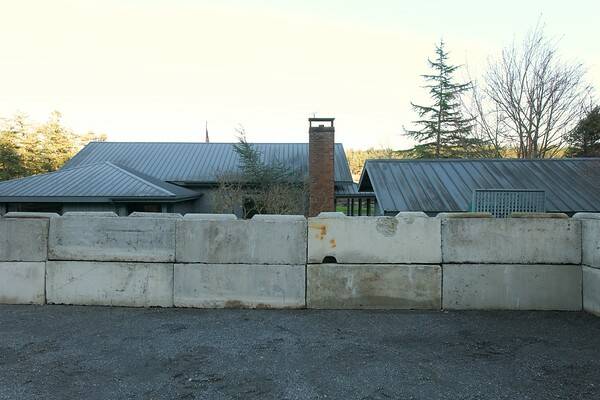
Without a lawful site, Public Works has been staging road debris at its cramped 1-acre lot near the community building on Blind Bay Road. Concrete barriers placed to hold the material have blocked parking that Shaw residents have used for decades and hampered access to a nearby Preservation Trust trailhead — a visible sign of a problem that has been building for years.
The Neck Point purchase, Huntemer says, was a matter of timing as much as need. Finding the right site on Shaw was no simple task. Buildable land is scarce throughout the county, and on Shaw, especially so. The County was looking for a property that offered natural screening, avoided wetlands and other environmentally sensitive areas and ideally had some existing development on it. The Neck Point Road property, he said, checked enough of those boxes to move forward through the standard siting process any facility like this would require.
Why the essential public facility designation?
The property is being proposed as an Essential Public Facility under Washington State’s Growth Management Act. The EPF designation exists because the Act prohibits “spot zoning” — rezoning a single parcel outside the broader intent of a Comprehensive Plan. Comprehensive Plan amendments are reserved for sweeping, areawide changes affecting multiple properties, not targeted modifications to one lot — meaning a private landowner, or even the County itself, could not simply rezone a single parcel to industrial use just because it suited a specific need. The EPF designation is the lawful mechanism that allows a government entity to identify a specific site, establish a genuine public need and make the necessary land use change — without it, the County would have no legal pathway to site a Public Works facility on Shaw, and the island’s infrastructure work would remain indefinitely stalled.
According to the application for an EPF filed by the Public Works Department dated Sept. 20, 2024, the County is using this pathway because “Public Works facilities, such as construction yards and outdoor storage yards, are restricted to industrial designated land uses. The County’s Comprehensive Plan Maps have no land use designations on Shaw Island that would allow for industrial land uses. Therefore, the County’s EPF siting and permitting process is the appropriate method for establishing a Public Works facility.”
“The proposed site would be used for equipment and material storage, administrative offices, and serve as an emergency service facility,” the County’s EPF application states. “All these activities meet the definition of an Essential Public Facility in San Juan County code.”
Opposition: A plan built over decades
That reasoning has not satisfied opponents. Lynn Bahrych, J.D., Ph.D., of the Shaw Island Alliance, in an open letter to the County Council published in the Journal on April 16, 2025, argues the community’s Subarea Plan — adopted more than 30 years ago with over 80% approval by island residents — explicitly prohibits industrial uses in the Rural Residential districts where the Neck Point property sits.
“The Shaw Island community has managed its affairs efficiently for decades with a simple, clear Subarea Plan which prohibits new industrial uses,” Bahrych wrote, in a guest column also published in the Journal on May 8, 2025. Opponents point out that once rezoned to rural industrial under the EPF process, the County’s own land-use tables would permit concrete batch plants, bulk fuel storage, commercial composting, garbage transfer, wrecking and salvage yards, and treatment of sewage and sludge — all potentially sited in the middle of a residential neighborhood.
“These uses are contrary to the purpose and spirit of the Shaw Subarea Plan,” Bahrych wrote. “It clearly prohibits all industrial uses in Rural Residential Districts, where the Neck Point property is located.”
The concerns are not limited to land use. Liz Hance, a local appraiser living on Shaw Island who is familiar with the property, noted that all neighboring parcels are residential, located on five- to ten-plus-acre parcels, many within 200 feet of the Neck Point site. Nearby property owners have contacted San Juan County Assessor John Kulseth to inquire about potential losses in value, drawing comparisons to residential parcels situated next to the Town of Friday Harbor’s sewer plant, busy roads or nearby gravel yards as examples of a measurable concept called external obsolescence, which results in a loss in property value based on an uncontrollable external factor. The directly adjacent neighboring 20-acre parcel has been recently listed for sale and has not moved — a situation Hance suggested may be connected to uncertainty over the property’s future use. “That’s a big concern for those neighboring property owners,” she said, citing sources of potential property value losses from increased truck traffic on Neck Point Road and potential air and water quality impacts from burning and material storage on the site.
Supporters: The work has to start
Not everyone on Shaw opposes the plan. Alice Nelsen, a longtime resident, said the County has been reasonable throughout. “They’ve been very gracious, working with us,” she said. “The Neck Point property is tucked back in the woods. You can’t see it. It doesn’t bother me.” Her priority, she said, is straightforward: “I want to see them making progress. They’re going to be cleaning out the ditches — that’s got to get going.”
Ann Meehan, a Shaw resident since the 1980s, put the cost of inaction plainly. “They would have to ship debris off-island — about $600 a truck. Waiting for the ferry, dumping it, turning around. That’s expensive and it’s a waste of time.” She added that urgency is real: “I want to get things done expediently — the Fourth of July is coming, and that’s a big deal for this island and its people.”
A signed letter from residents Amber Borner, Andrew Borner, Debbie Anderson and Philip Burkhardt, published in the Journal’s editorial section on April 21, 2025, echoed the same view. “There are not many properties to choose from, and in many ways, this one fits the bill,” they wrote. “This is a long-term investment in our community that will be more efficient and save money over time.” The group argued that a dedicated on-island yard would mean less disruption during road work and faster emergency response when roads and culverts fail in the face of storms or climate-related events. They also asked that Public Works develop the site with respect for noise, visual buffers, air quality and groundwater protection — and that once the move is complete, the County vacate and clean up the Blind Bay property and work with residents, through a dedicated steering committee, to determine its best future use.
What comes next
Huntemer says if the Neck Point facility is approved, the Blind Bay lot near the community building would be vacated and returned to community use. “I’m open to everything,” he said. “I would turn to the community of Shaw to bring forward their ideas.”