Bill would ban some school isolation, restraint
Published 1:30 am Saturday, February 28, 2026
By Annika Hauer
WA State Journal
A proposed bill would ban the creation of isolation rooms and the use of certain restraints unless a student’s behavior is to the point of harming themselves or others.
Pilot programs show that preventing student behavior escalation, learned through professional development, is key to reducing the use of restraint and isolation. A former version of House Bill 1795 included $13 million for providing that training, but that money has been removed to bring the bill’s cost to zero.
Isolation and restraint are primarily used on elementary school students with disabilities who are male, according to a report by the American Civil Liberties Union and Disability Rights Washington. Black students are almost twice as likely as their white peers to be restrained or isolated, and low-income students are 2.5 times as likely as their non-low-income counterparts.
Isolation usually looks like a student locked in a padded cell the size of a closet, often built into a corner of special education classrooms. Students and parents of students have repeatedly expressed in testimony the horror of being locked in these rooms away from any adult, especially when the child is young and in emotional distress.
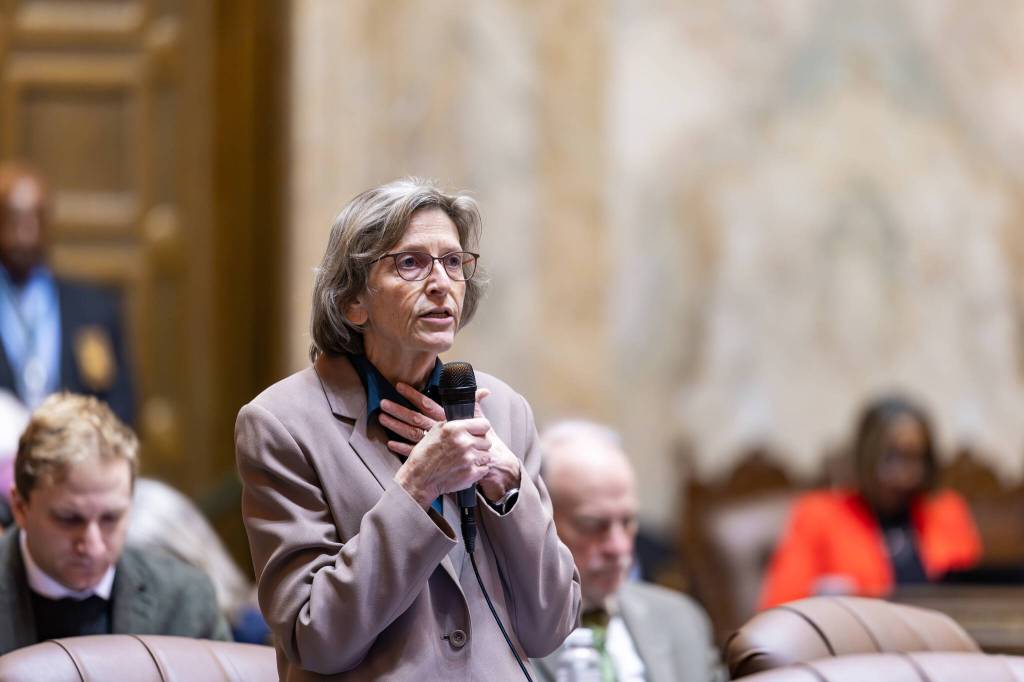
“We know when children experience the traumatic events of an isolation or a restraint it’s not just a moment, it affects them their whole lives,” Rep. Lisa Callan, D-Issaquah, and bill sponsor, said. “We want to make sure that a student feels like they can belong in a school, that they want to come to school. If you are experiencing high levels of isolation and restraint, that’s the last thing you’re going to do.”
In the 2024-25 school year, the Office of Superintendent of Public Instruction reports nearly 4,000 students were restrained or isolated 22,752 times.
In current law, isolation and restraint are allowed as a last-resort use when there is “imminent serious harm,” for example, a child raising a chair to throw at someone or banging their head on a wall. Or, if a child runs into the street, an educator may grab and hold the child to stop them.
Those conditions do not change under this bill. Rather, the bill tries to address the unnecessary use of restraint and isolation still happening today.
HB 1795 establishes that restraint and isolation cannot be a planned response to escalated behavior, often detailed in a student’s Individualized Education Plan, unless the parent or guardian has consented and a licensed physician has deemed it necessary.
Though former versions of HB 1795 banned isolation completely and a wider set of restraints, the bill currently bans solely the use of life‑threatening restraint and mechanical, chemical or physical restraint devices, like non-prescribed Benadryl or handcuffs. The bill also bans building more isolation rooms. Existing ones are not affected.
In 2023, while that former bill did not pass, the Legislature designated funding to OSPI to make more than 20 school districts “pilot” sites for the work to eliminate isolation and reduce restraint.
According to OSPI, 71% of project sites had a decrease in incidents of restraint and isolation last school year.
As seen on an OSPI map, included were the Anacortes, Bremerton, Central Valley, Concrete, Davenport, Edmonds, Fife, Kelso, Lakewood, North Thurston, Oakville, Reardan-Edwall, Rochester, Snoqualmie Valley, South Whidbey and Vancouver school districts.
Auburn, Bainbridge, Centralia, Mukilteo and Spokane school districts were pilots that were designated “demonstration” versions where isolation and restraint reduction work was already ongoing. The grant built upon that work.
In the Auburn School District, work began following a high of 779 incidents of restraint and isolation in the 2019-20 school year. The special education team, led by director Patrick Mulick, decided to address it.
“Reducing restraint and isolation, you don’t do it just by saying, ‘We’re not going to do this anymore,’” Mulick said. “It’s by identifying the other things that you need to do.”
The special education team formed a committee to make recommendations specific to Auburn classrooms, hired a behavioral analyst to study certain student cases and made modified de-escalation training from vendor Safety Care available to librarians and recess teachers.
In the 2024-25 school year, Auburn had 253 reported restraint and isolation incidents. Isolation specifically went down by 95% since 2019 — mainly because the last isolation room was taken out during that time, Mulick said.
It has not been simple or easy work, Mulick said. It’s hard, and it took Auburn School District choosing to prioritize the issue, he said.
Each change is about prevention of escalation in the first place, Mulick said, and that comes from understanding behavioral needs and centering inclusion from the get-go. This has been schoolwide, and every child, special education and general education alike, benefits.
“It requires knowing the students and knowing some of the signs that they’re starting to escalate,” Mulick said. “When this work is done at its best, we have far fewer escalations to respond to.”
When Auburn was designated a “demonstration” site for isolation and restraint reduction efforts, part of the roughly $50,000 annual grant money was used for an even wider school effort — building “regulation spaces” into every classroom of two of Auburn’s elementary schools.
The approximately 1,200 students of these schools can use this quieter corner of the classroom to “get their mind ready for learning again.”
If a student is getting upset, Mulick said, teachers are trained to avoid “taking back control” of the situation by firmly yelling and standing over the student, which usually escalates the situation, and instead crouch at the student’s level, empathize, give them options and ultimately “give the control back over to the student.”
During its House floor debate, legislators pushed back against HB 1795’s lack of training requirements and funding.
“It’s that professional development … matters for our teachers and staff,” Rep. Travis Couture, R-Allyn, said. “But that is not present in this bill, and so it just becomes a restrictive bill.”
Legislators in support of the bill said it is a small but important step in the right direction.
An agreement on the floor was that prevention is key to de-escalation. An amendment by Rep. Carolyn Eslick, R-Sultan, added that it is the Legislature’s intention to “improve the safety and well-being of staff members and students by implementing a trauma-informed professional development program on evidence-informed alternatives to restraint and isolation,” by 2031.
To stay alive now, the bill must go through public hearings and votes in the Senate.
School districts across Washington have done work on their own accord to reduce restraint and isolation use, many through the use of Safety Care training.
“I know budget is very limiting right now,” Mulick said, “but we, all educators in Washington state, can be asking ourselves the question, ‘But what is it that we can do, to better improve our behavioral supports? What is it that we can do with what we have, with the time, the space, resources that exist now?’ ”
Rachel Amagalian testified Feb. 19 as “other” on the bill. She is a special education teacher in the Central Kitsap School District who took Safety Care training, and she called on the room of senators to keep professional development like hers at the forefront of policies.
“Through these trainings, I have learned real strategies that I can model for my students and in turn my students have tools to support their own emotional regulation,” she said.
The Washington State Journal is a nonprofit news website operated by the WNPA Foundation. To learn more, go to wastatejournal.org.